WORKING WITH FRACTIONS8
8.1 Multiplication of Fractions
Aaron walks 3 kilometres in 1 hour. How far can he walk in 5 hours?This is a simple question. We know that to find the distance, we need to find the product of 5 and 3, i.e., we multiply 5 and 3.
Distance covered in 1 hour = 3 km.
Therefore,
Distance covered in 5 hours
= 5 × 3 km
= 3 + 3 + 3 + 3 + 3 km
= 15 km.
Aaron’s pet tortoise walks at a much slower pace. It can walk only 14 kilometre in 1 hour. How far can it walk in 3 hours?
Here, the distance covered in an hour is a fraction. This does not matter. The total distance covered is calculated in the same way, as multiplication.
Distance in 1 hour
14 km
Distance in 3 hour
Distance covered in 1 hour = 14 km.
Therefore, distance covered in 3 hours = 3 × 14 km
= 14 + 14 + 14 km
= 34 km.
The tortoise can walk 34 km in 3 hours.
Let us consider a case where the time spent walking is a fraction of an hour.
We saw that Aaron can walk 3 kilometres in 1 hour. How far can he
walk in 15 hours?
We continue to calculate the total distance covered through multiplication.
Distance in 1 hour
03 km
Distance in 15 hour
Distance covered in 15 hours = 15 × 3 km.
Finding the product:
Distance covered in 1 hour = 3 km.
In 15 hours, distance covered is equal to the length we get by dividing
3 km into 5 equal parts, which is 35 km.
This tells us that 15 × 3 = 35 .
How far can Aaron walk in 25 hours?
Once again, we have —
Distance covered = 25 × 3 km.
Distance in 1 hour
Distance in
15 hour
Distance in 25 hour
Finding the product:
1. We can first find the distance covered in 15 hours.
2. Since, the duration 25 is twice 15, we multiply this distance by 2 to
get the total distance covered.
Here is the calculation.
Distance covered in 1 hour = 3 km.
1. Distance covered in 15 hour
= The length we get by dividing 3 km in 5 equal parts
= 35 km.
2. Multiplying this distance by 2, we get
2 × 35 = 65 km.
From this we can see that
25 × 3 = 65.
Discussion
MultiplierMultiplicand
We did this multiplication as follows:
25 × 3
• First, we divided the multiplicand, 3 , by the denominator of the multiplier, 5, to get 35.
• We then multiplied the result by the numerator of the multiplier,
that is 2, to get 65.
MultiplierMultiplicand
Thus, whenever we need to multiply a fraction and a whole number, we follow the steps above.
25 × 3
3 ÷ 5 = 35
25
Example 1: A farmer had 5
grandchildren. She distributed 23 acre
25
2 × 35 = 65
of land to each of her grandchildren.
How much land in all did she give to her grandchildren?
5 × 23 = 23 + 23 + 23 + 23 + 23 = 103 .
Example 2: 1 hour of internet time costs ₹8. How much will 1 14 hours
of internet time cost?
1 14 hours is 54 hours (converting from a mixed fraction).
Cost of 54 hour of internet time = 54 × 8
= 5 × 84
= 5 × 2= 10.
It costs ₹10 for 1 14 hours of internet time.
Figure it Out
1. Tenzin drinks 12 glass of milk every day. How many glasses of milk
does he drink in a week? How many glasses of milk did he drink in the month of January?
2. A team of workers can make 1 km of a water canal in 8 days. So, in one day, the team can make ___ km of the water canal. If they work 5 days a week, they can make ___ km of the water canal in a week.
3. Manju and two of her neighbours buy 5 litres of oil every week and share it equally among the 3 families. How much oil does each family get in a week? How much oil will one family get in 4 weeks?
4. Safia saw the Moon setting on Monday at 10 pm. Her mother, who is
a scientist, told her that every day the Moon sets 56 hour later than
the previous day. How many hours after 10 pm will the moon set on Thursday?
5. Multiply and then convert it into a mixed fraction:
(a) 7 × 35
(b) 4 × 13
(c) 97 × 6
(d) 1311 × 6
So far, we have learnt multiplication of a whole number with a fraction, and a fraction with a whole number. What happens when both numbers in the multiplication are fractions?
Multiplying Two Fractions
We know, that Aaron’s pet tortoise can walk only 14 km in 1 hour. How far can it walk in half an hour?
HourDistance
Following our approach of using multiplication to solve such problems, we have,
114
Distance covered in 12 hour = 12 × 14 km.
12?
Finding the product:
Distance covered in 1 hour = 14 km.
Therefore, the distance covered in 12 an hour is the length we get by
dividing 14 into 2 equal parts.
To find this, it is useful to represent fractions using the unit square to stand for a “whole”.
14
Unit square as a “whole” 14 of the whole
Now we divide this 14 into 2 equal parts. What do we get?
What fraction of the whole is shaded?
Since the whole is divided into 8 equal parts
and one of the parts is shaded, we can say that 18
of the whole is shaded. So, the distance covered
by the tortoise in half an hour is 18 km.
This tells us that 12 × 14 = 18.
14 divided into 2 equal parts
If the tortoise walks faster and it can cover 25 km in 1 hour, how far will
it walk in 34 of an hour?
Distance covered = 34 × 25.
Finding the product:
(i) First find the distance covered in 14 of an hour.
(ii) Multiply the result by 3, to get the distance covered in 34 of an
hour.
(i) Distance in km covered in 14 of an hour
whole
= The quantity we get by dividing 25 into 4 equal parts.
25
Taking the unit square as the whole, the
shaded part (in Fig. 8.1) is a region we get
when we divide 25 into 4 equal parts.
How much of the whole is it?
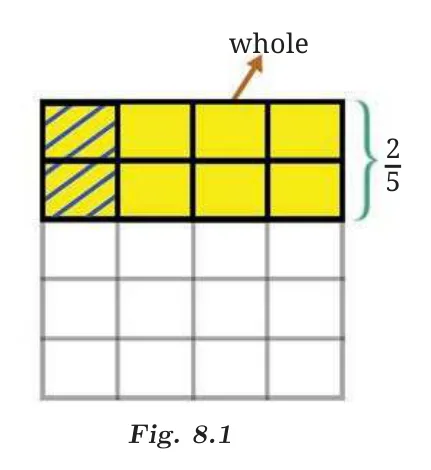
The whole is divided into5 rows and 4 columns,creating 5 × 4 = 20 equal parts.
Number of these parts shaded = 2.
So, the distance covered in 14 of an hour = 220 .
(ii) Now, we need to multiply 220 by 3.
Distance covered in 34 of an hour = 3 × 220
= 620 .
So, 34 × 25 = 620 = 310.
Discussion
In the case of a fraction multiplied by another fraction, we follow a method similar to the one we used, when we multiplied a fraction by a whole number. We multiplied as follows:
MultiplierMultiplicand
34 × 25
25 ÷ 4 = 220 Divide the multiplicand by 4.34
3 × 220 = 620 = Divide the multiplicand by 3.34
Math Talk
Using this understanding, multiply 54 × 32.
First, let us represent 32, taking the unit square as
whole
the whole. Since, the fraction 32 is one whole and a
half, it can be seen as follows:
32
Following the steps of multiplication, we need to
first divide this fraction 32 into 4 equal parts. It can
be done as shown in the Fig. 8.2 with the yellow
shaded region representing the fraction obtained
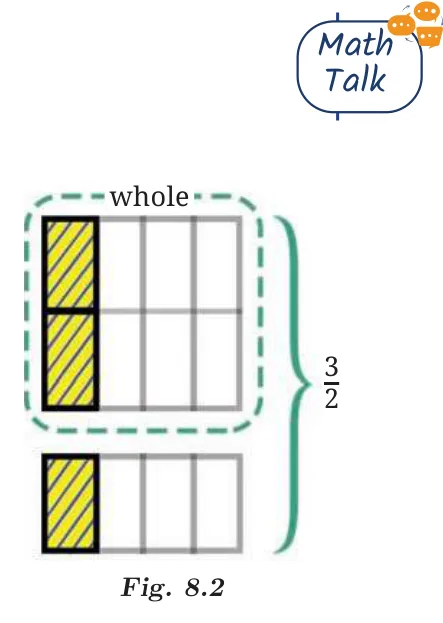
by dividing 32 into 4 equal parts. What is its value?
We see that the whole is divided into —2 rows and 4 columns,creating 2 × 4 = 8 equal parts.Number of parts shaded = 3.
So the yellow shaded part = 38.
Now, the next step is multiplying this result by 5. This gives the
product of 54 and 32:
54 × 32 = 5 × 38 = 158 .
Connection between the Area of a Rectangle and Fraction Multiplication
In the Fig. 8.3, what is the length and breadth of the shaded rectangle? Since we started with a unit square (of side 1 unit), the length and
breadth are 12 unit and 14 unit.
What is the area of this rectangle? We see that 8 such rectangles give the square of area 1 square unit. So, the area of each rectangle
18
is 18 square units.
Do you see any relation between the area and the product of length and breadth?
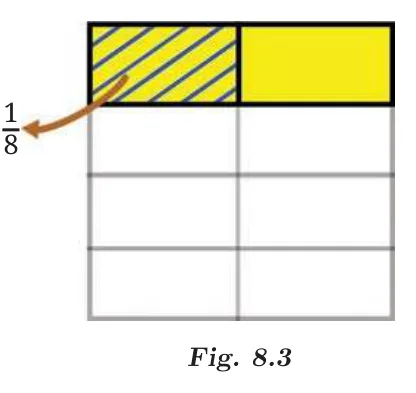
The area of a rectangle of fractional sides equals the product of its sides.In general, if we want to find the product of two fractions, we can find the area of the rectangle formed with the two fractions as its sides.
Figure it Out
1. Find the following products. Use a unit square as a whole for representing the fractions:
(a) 13 × 15
(b) 14 × 13
(c) 15 × 12
(d) 16 × 15
Now, find 112 × 118.
Doing this by representing the fractions using a unit square is cumbersome. Let us find the product by observing what we did in the above cases.In each case, the whole is divided into rows and columns. The number of rows is the denominator of the multiplicand, which is 18 in this case.The number of columns is the denominator of the multiplier, which is 12 in this case.Thus, the whole is divided into 18 × 12 equal parts.
118
18 parts
So, 118 × 112 = 1(18×12) = 1216.
Thus, when two fractional units are
12 parts
multiplied, their product is
1(product of denominators).
We express this as:
1b × 1d = 1b × d .
2. Find the following products. Use a unit square as a whole for representing the fractions and carrying out the operations.
(a) 23 × 45 (b) 14 × 23
(c) 35 × 12 (d) 46 × 35
Multiplying Numerators and Denominators
Now, find 512 × 718.
Like the previous case, let us find the product by performing the multiplication, step by step.First, the whole is divided into 18 rows and 12 columns creating 12 × 18 equal parts.
718
18 parts
The value we get by dividing 718 into 12 equal
parts is 7(12 × 18) .
12 parts
Then, we multiply this result by 5 to get
the product. This is (5 × 7)(12 × 18).
718
So, 512 × 78 = (5 × 7)(12 × 18) = 35216.
18 parts
From this we can see that, in general,
ab × cd = a × cb × d .
12 parts
This formula was first stated in this general form by Brahmagupta in his Brāhmasphuṭasiddhānta in 628 CE. The formula above works even when the multiplier or multiplicand is a whole number. We can simply rewrite the whole number as a fraction with denominator 1. For example,
3 × 34 can be written 31 × 34
= 3×31×4 = 94.
And,
35 × 4 can be written 35 × 41
= 3 × 45 × 1 = 125 .
Multiplication of Fractions — Simplifying to Lowest Form
Multiply the following fractions and express the product in its lowest form:
127 × 524
Instead of multiplying the numerators (12 and 5) and denominators (7 and 24) first and then simplifying, we could do the following:
127 × 524 = 12 × 57 × 24
We see that both the circled numbers have a common factor of 12. We know that a fraction remains the same when the numerator and denominator are divided by the common factor. In this case, we can divide them by 12.
12 × 57 × 24 = 1 × 57 × 2 = 514
Let us use the same technique to do one more multiplication.
1415 × 2542
14 × 2515 × 42 = 1 × 53 × 3 = 59 .
33
When multiplying fractions, we can first divide the numerator and denominator by their common factors before multiplying the numerators and denominators. This is called cancelling the common factors.
A Pinch of History
In India, the process of reducing a fraction to its lowest terms — known as apavartana — is so well known that it finds mention even in a non-mathematical work. A Jaina scholar Umasvati (c. 150 CE) used it as a simile in a philosophical work.
Figure it Out
1. A water tank is filled from a tap. If the tap is open for 1 hour, 710 of
the tank gets filled. How much of the tank is filled if the tap is open for
(a) 13 hour ____________
(b) 23 hour ____________
(c) 34 hour ____________
(d) 710 hour ____________
TryThis
(e) For the tank to be full, how long should the tap be running?
2. The government has taken 16 of Somu’s land to build a road.
What part of the land remains with Somu now? She gives half of
the remaining part of the land to her daughter Krishna and 13 of
it to her son Bora. After giving them their shares, she keeps the
remaining land for herself.
(a) What part of the original land did Krishna get?
(b) What part of the original land did Bora get?
(c) What part of the original land did Somu keep for herself?
3. Find the area of a rectangle of sides 3 34 ft and 9 35 ft.
4. Tsewang plants four saplings in a row in his garden. The distance
between two saplings is 34 m. Find the distance between the first
and last sapling. [Hint: Draw a rough diagram with four saplings
with distance between two saplings as 34 m]
5. Which is heavier: 1215 of 500 grams or 320 of 4 kg?
Is the Product Always Greater than the Numbers Multiplied?
Since, we know that when a number is multiplied by 1, the product remains unchanged, we will look at multiplying pairs of numbers where neither of them is 1.When we multiply two counting numbers greater than 1, say 3 and 5, the product is greater than both the numbers being multiplied.
3 × 5 = 15
The product, 15, is more than both 3 and 5.
But what happens when we multiply 14 and 8?
14 × 8 = 2
In the above multiplication the product, 2, is greater than 14, but less
than 8.
What happens when we multiply 34 and 25 ?
34 × 25 = 620
Let us compare this product 620 with the numbers 34 and 25. For this,
let us express 34 as 1520 and 25 as 820.
From this we can see that the product is less than both the numbers.When do you think the product is greater than both the numbers multiplied, when is it in between the two numbers, and when is it smaller than both?[Hint: The relationship between the product and the numbers multiplied depends on whether they are between 0 and 1 or they are greater than 1. Take different pairs of numbers and observe their product. For each multiplication, consider the following questions.]
SituationMultiplicationRelationship
Situation 1Both numbers are greater than 1
The product (163 ) is
greater than both the numbers
(e.g., 43 × 4)
Situation 2Both numbers are between 0 and 1
The product ( 310) is
less than both the numbers
(e.g., 34 × 25)
Situation 3One number is between 0 and 1, and one number is greater than 1
The product (154 ) is
less than the number greater than 1 and greater than the number between 0 and 1
(e.g., 34 × 5)
Create more such examples for each situation and observe the relationship between the product and the numbers being multiplied.
What can you conclude about the relationship between the numbers multiplied and the product? Fill in the blanks:
• When one of the numbers being multiplied is between 0 and 1, the product is ____________ (greater/less) than the other number.
• When one of the numbers being multiplied is greater than 1, the product is _____________ (greater/less) than the other number.
Order of Multiplication
12
14
18
We know that 12 × 14 = 18.
14
12
18
Now, what is 14 × 12 ?
That is 18 too.
In general, note that the area of a rectangle remains the same even if the length and breadth are interchanged. The order of multiplication does not matter. Thus,
ab × cd = cd × ab.
This can also be seen from Brahmagupta’s formula for multiplying fractions.
8.2 Division of Fractions
What is 12 ÷ 4? You know this already.But can this problem be restated as a multiplication problem?What should be multiplied by 4 to get 12? That is,
DividendDivisor
12 ÷ 4 = 3
Quotient
4 × ? = 12
We can use this technique of converting division into multiplication problems to divide fractions.
What is 1 ÷ 23 ?
Let us rewrite this as a multiplication problem
23 × ? = 1
What should be multiplied by 23 to get the product 1?
If we somehow cancel out the 2 and the 3, we are left with 1.
23 × 32 = 1
Answer
So,
1 ÷ 23 = 32.
Let us try another problem:
3 ÷ 23.
This is the same as
23 × ? = 3.
Can you find the answer?
We know what to multiply 23 by to get 1. We just need to multiply that
by 3 to get 3. So,
23 × 32 × 3 = 3
Answer
So,
3 ÷ 23 = 32 × 3 = 92.
What is 15 ÷ 12 ?
Rewriting it as a multiplication problem, we have
12 × ? = 15.
How do we solve this?
12 × 2 × 15 = 15
Answer
So,
15 ÷ 12 = 2 × 15 = 25.
What is 23 ÷ 35 ?
Rewriting this as multiplication, we have
35 × ? = 23.
How will we solve this?
35 × 53 × 23 = 23
Answer
So,
23 ÷ 35 = 53 × 23 = 109 .
Discussion
In each of the division problems above, observe how we found the answer. Can we frame a rule that tells us how to divide two fractions?Let us consider the previous problem.In every division problem we have a dividend, divisor and quotient. The technique we have been using to get the quotient is:
23 ÷ 35
Dividend
Divisor
= 53 × 23 = 109
1. First, find the number which gives
1 when multiplied by the divisor. We see that the resulting number is a fraction whose numerator is the divisor’s denominator and denominator is the divisor’s numerator.
Quotient
For the divisor 35 this fraction is 53. We call 53 the reciprocal of 35.
When we multiply a fraction by its reciprocal, we get 1. So, the first step in our technique is to find the divisor’s reciprocal.
2. We then multiply the dividend with this reciprocal to get the quotient.
Summarising, to divide two fractions:
• Find the reciprocal of the divisor
• Multiply this by the dividend to get the quotient.
So, ab ÷ cd = dc × ab = d × ac × b.
This can be rewritten as:
ab ÷ cd = ab × dc = a × db × c.
As with methods and formulas for addition, subtraction, and multiplication of fractions that you learnt earlier, this method and formula for division of fractions, in this general form, was first explicitly stated by Brahmagupta in his Brāhmasphuṭasiddhānta (628 CE).
So, to evaluate, for example, 23 ÷ 35 using Brahmagupta’s formula
above, we write:
23 ÷ 35 = 23 × 53 = 2 × 53 × 3 = 109 .
Dividend, Divisor and the Quotient
When we divide two whole numbers, say 6 ÷ 3, we get the quotient 2. Here the quotient is less than the dividend.
6 ÷ 3 = 2, 2 < 6
But what happens when we divide 6 by 14 ?
6 ÷ 14 = 24.
Here the quotient is greater than the dividend!
What happens when we divide 18 by 14 ?
18 ÷ 14 = 12.
Here too the quotient is greater than the dividend.When do you think the quotient is less than the dividend and when is it greater than the dividend?Is there a similar relationship between the divisor and the quotient?
Use your understanding of such relationships in multiplication to answer the questions above.
8.3 Some Problems Involving Fractions
Example 3: Leena made 5 cups of tea. She used 14 litre of milk for this.
How much milk is there in each cup of tea?
14 litres of 5 cups
Milk in 1 cup
Leena used 14 litres of milk in 5 cups of tea. So, in 1 cup of tea the
volume of milk should be:
14 ÷ 5.
Writing this as multiplication, we have:
5 × (milk per cup) = 14.
We perform the division as follows as per Brahmagupta’s method:
The reciprocal of 5 (the divisor) is 15.
Multiplying this reciprocal by the dividend ( 14 ), we get
15 × 14 = 120.
So, each cup of tea has 120 litre of milk.
Example 4: Some of the oldest examples of working with non-unit fractions occur in humanity’s oldest geometry texts, the Śhulbasūtra. Here is an example from Baudhāyana’s Śhulbasūtra (c. 800 BCE).
Cover an area of 7 12 square units with square bricks each of whose
sides is 15 units.
How many such square bricks are needed?
Each square brick has an area of 15 × 15 = 125 square units.
The total area to be covered is 7 12 sq. units = 152 sq. units.
As (Number of bricks) × (Area of a brick) = Total Area,
Number of bricks = 152 ÷ 125.
The reciprocal of the divisor is 25.Multiplying the reciprocal by the dividend, we get
25 × 152 = 25 × 152 = 3752 .
Example 5: This problem was posed by Chaturveda Pṛithūdakasvāmī (c. 860 CE) in his commentary on Brahmagupta’s book Brāhmasphuṭasiddhānta.
Four fountains fill a cistern. The first fountain can fill the cistern in a day. The second can fill it in half a day. The third can fill it in a quarter of a day. The fourth can fill the cistern in one fifth of a day. If they all flow together, in how much time will they fill the cistern? Let us solve this problem step by step.In a day, the number of times —
• the first fountain will fill the cistern is 1÷ 1 = 1
• the second fountain will fill the cistern is 1 ÷ 12 = _____
• the third fountain will fill the cistern is 1 ÷ 14= _____
• the fourth fountain will fill the cistern is 1 ÷ 15 = _____
The number of times the four fountains together will fill the cistern in a day is ___ + ____ + ___ + ____ = 12.
Thus, the total time needed by the four fountains to fill the cistern
together is 112 days.
Fractional Relations
Here is a square with some lines drawn inside.
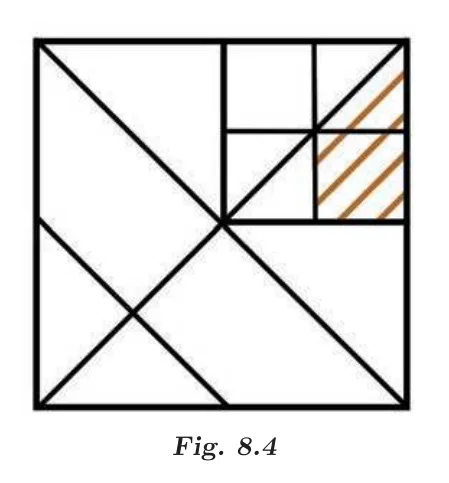
What fraction of area of the whole square does the shaded region occupy?
Math Talk
There are different ways to solve this problem. Here is one of them:Let the area of the whole square be 1 square unit.
We can see that the top right square (in Fig. 8.5), occupies 14 of the
area of the whole square.
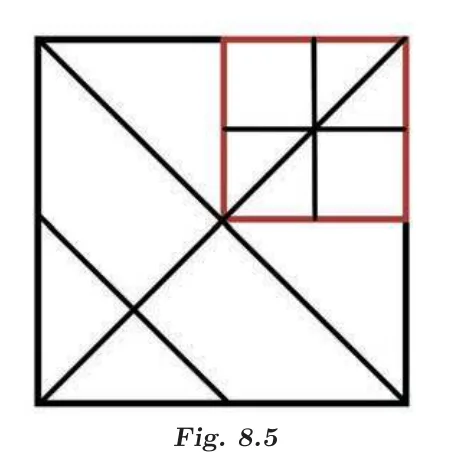
Area of red square = 14 square units.
Fig, 8.6
Let us look at this red square. The area of the triangle inside it (coloured yellow) is half the area of the red square. So,
the area of the yellow triangle = 12 × 14 = 18 square units.
What fraction of this yellow triangle is shaded?
The shaded region occupies 34 of the area of the
yellow triangle. Are you able to see why?
The area of shaded part = 34 × 18 = 332 square units.
Thus, the shaded region occupies 332 of the area of the whole square.
In each of the figures given below, find the fraction of the big square that the shaded region occupies.
We will solve more interesting problems of this kind in a later chapter.
A Dramma-tic Donation
The following problem is translated from Bhāskarāchārya’s (Bhāskara II’s) book, Līlāvatī, written in 1150 CE.
“O wise one! A miser gave to a beggar 15 of 116 of 14 of 12 of 23 of 34 of
a dramma. If you know the mathematics of fractions well, tell me O
child, how many cowrie shells were given by the miser to the beggar.”
Dramma refers to a silver coin used in those times. The tale says that 1 dramma was equivalent to 1280 cowrie shells. Let’s see what fraction of a dramma the person gave:
12 × 23 × 34 × 15 × 116 × 14)
th part of a dramma.
Evaluating it gives 67680 .
Upon simplifying to its lowest form, we get
67680 = 11280.
So, one cowrie shell was given to the beggar.You can see in the answer Bhāskarāchārya’s humour! The miser had given the beggar only one coin of the least value (cowrie).Around the 12th century, several types of coins were in use in different kingdoms of the Indian subcontinent. Most commonly used were gold coins (called dinars/gadyanas and hunas), silver coins (called drammas/tankas), copper coins (called kasus/panas and mashakas), and cowrie shells. The exact conversion rates between these coins varied depending on the region, time period, economic conditions, weights of coins and their purity. Gold coins had high-value and were used in large transactions and to store wealth. Silver coins were more commonly used in everyday transactions. Copper coins had low-value and were used in smaller transactions. Cowrie shells were the lowest denomination and were used in very small transactions and as change.If we assume 1 gold dinar = 12 silver drammas, 1 silver dramma = 4 copper panas, 1 copper pana = 6 mashakas, and 1 pana = 30 cowrie shells,
112 × 14)
1 copper pana = 148 gold dinar (
1 cowrie shell =____ copper panas
1 cowrie shell =____ gold dinar.
A Pinch of History
As you have seen, fractions are an important type of number, playing a critical role in a variety of everyday problems that involve sharing and dividing quantities equally. The general notion of non-unit fractions as we use them today — equipped with the arithmetic operations of addition, subtraction, multiplication, and division — developed largely in India. The ancient Indian geometry texts called the Śhulbasūtra — which go back as far as 800 BCE, and were concerned with the construction of fire altars for rituals — used general non-unit fractions extensively, including performing division of such fractions as we saw in Example 3.
Fractions even became commonplace in the popular culture of India as far back as 150 BCE, as evidenced by an offhand reference to the reduction of fractions to lowest terms in the philosophical work of the revered Jain scholar Umasvati.
General rules for performing arithmetic operations on fractions — in essentially the modern form in which we carry them out today — were first codified by Brahmagupta in his Brāhmasphuṭasiddhānta in 628 CE. We have already seen his methods for adding and subtracting general fractions. For multiplying general fractions, Brahmagupta wrote:
“Multiplication of two or more fractions is obtained by taking the product of the numerators divided by the product of the denominators.” (Brāhmasphuṭasiddhānta, Verse 12.1.3)
ab × cd = a × cb × d .
That is,
For division of general fractions, Brahmagupta wrote:
“The division of fractions is performed by interchanging the numerator and denominator of the divisor; the numerator of the dividend is then multiplied by the (new) numerator, and the denominator by the (new) denominator.”
Bhāskara II in his book Līlāvatī in 1150 CE clarifies Brahmagupta‘s statement further in terms of the notion of reciprocal:
“Division of one fraction by another is equivalent to multiplication of the first fraction by the reciprocal of the second.” (Līlāvatī, Verse 2.3.40)
Both of these verses are equivalent to the formula:
ab ÷ cd = ab ×dc = a × db × c .
Bhāskara I, in his 629 CE commentary Āryabhaṭīyabhāṣhya on Aryabhata’s 499 CE work, described the geometric interpretation of multiplication of fractions (that we saw earlier) in terms of the division of a square into rectangles via equal divisions along the length and breadth. Many other Indian mathematicians, such as Śhrīdharāchārya (c. 750 CE), Mahāvīrāchārya (c. 850 CE), Caturveda Pṛithūdakasvāmī (c. 860 CE), and Bhāskara II (c. 1150 CE) developed the usage of arithmetic of fractions significantly further. The Indian theory of fractions and arithmetic operations on them was transmitted to, and its usage developed further, by Arab and African mathematicians such as al-Hassâr (c. 1192 CE) of Morocco. The theory was then transmitted to Europe via the Arabs over the next few
120
14
15
Bhāskara I’s visual explanation that
15 × 14 = 120
centuries, and came into general use in Europe in only around the 17th century, after which it spread worldwide. The theory is indeed indispensable today in modern mathematics.
Figure it Out
1. Evaluate the following:
3 ÷ 79
144 ÷ 223÷ 23
146 ÷ 73
82 ÷ 415
43 ÷ 34
74 ÷ 17
15 ÷ 19
16 ÷ 11123 23 ÷ 1 38
2. For each of the questions below, choose the expression that describes the solution. Then simplify it.
(a) Maria bought 8 m of lace to decorate the bags she made for
school. She used 14 m for each bag and finished the lace. How
many bags did she decorate?
(i) 8 × 14 (ii) 18 × 14
(iii) 8 ÷ 14 (iv) 14 ÷ 8
(b) 12 meter of ribbon is used to make 8 badges. What is the
length of the ribbon used for each badge?
(i) 8 × 12 (ii) 12 ÷ 18
(iii) 8 ÷ 12 (iv) 12 ÷ 8
(c) A baker needs 16 kg of flour to make one loaf of bread. He has
5 kg of flour. How many loaves of bread can he make?
(i) 5 × 16 (ii) 16 ÷ 5
(iii) 5 ÷ 16 (iv) 5 × 6
3. If 14 kg of flour is used to make 12 rotis, how much flour is used to
make 6 rotis?
4. Pāṭīgaṇita, a book written by Sridharacharya in the 9th century
CE, mentions this problem: “Friend, after thinking, what sum will
be obtained by adding together 1 ÷ 16 , 1 ÷ 110 , 1 ÷ 113 , 1 ÷ 19 , and
1 ÷ 12”. What should the friend say?
5. Mira is reading a novel that has 400 pages. She read 15 of the pages
yesterday and 310 of the pages today. How many more pages does
she need to read to finish the novel?
6. A car runs 16 km using 1 litre of petrol. How far will it go using 2 34 litres of petrol?
7. Amritpal decides on a destination for his vacation. If he takes a
train, it will take him 5 16 hours to get there. If he takes a plane, it
will take him 12 hour. How many hours does the plane save?
8. Mariam’s grandmother baked a cake. Mariam and her cousins
finished 45 of the cake. The remaining cake was shared equally by
Mariam’s three friends. How much of the cake did each friend get?
9. Choose the option(s) describing the product of (
565465 × 707676 ):
(a) > 565465 (b) < 565465
(c) > 707676 (d) < 707676(e) > 1 (f) < 1
10. What fraction of the whole square is shaded?
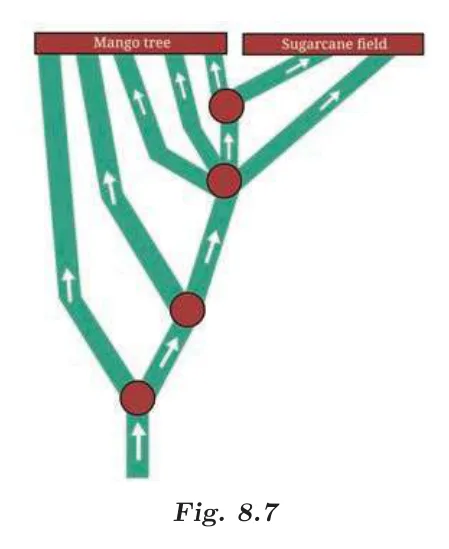
11. A colony of ants set out in search of food. As they search, they keep splitting equally at each point (as shown in the Fig. 8.7) and reach two food sources, one near a mango tree and another near a sugarcane field. What fraction of the original group reached each food source?
12. What is 1 – 12 ?
(1 – 12) × (1 – 13) ?
(1 – 12) × (1 – 13) × (1 – 14) × (1 – 15) ?
(1 – 12) × (1 – 13) × (1 – 14) × (1 – 15) × (1 – 16) × (1 – 17) × (1 – 18) × (1 – 19) × (1 – 110) ?
Make a general statement and explain.
SUMMARY
• Brahmagupta’s formula for multiplication of fractions:
ab × cd = a × cb × d .
• When multiplying fractions, if the numerators and denominators have some common factors, we can cancel them first before multiplying the numerators and denominators.• In multiplication — when one of the numbers being multiplied is between 0 and 1, the product is less than the other number. If one of the numbers being multiplied is greater than 1, then the product is greater than the other number.
• The reciprocal of a fraction ab is ba. When we multiply a fraction by its reciprocal, the product is 1.• Brahmagupta’s formula for division of fractions:
ab ÷ cd = ab × dc = a × db × c.
• In division — when the divisor is between 0 and 1, the quotient is greater than the dividend. When the divisor is greater than 1, the quotient is less than the dividend.
Chess Puzzles — Non-attacking Queens
Chess is a popular 2-player strategy game. This game has its origins in India. It is played on an 8 × 8 chequered grid. There are 2 sets of pieces — black and white — one set for each player. Find out how each piece should move and the rules of the game.Here is a famous chess-based puzzle. From its current position, a Queen piece can move along the horizontal, vertical or diagonal. Place 4 Queens such that no 2 queens attack each other. For example, the arrangement below is not valid as the queens are in the line of attack of each other.
Now, place 8 queens on this 8 × 8 grid so that no 2 queens attack each other!
Learning Material Sheets
Note
CHAPTER – 8
Page No. 176
Figure it out
1. Tenzin drinks 𝟏
𝟐 glass of milk every day. How many glasses of milk
does he drink in a week? How many glasses of milk did he drink in the month of January?
Ans: Quantity of milk that Tenzin drinks in a week = 7
2 glasses.
Quantity of milk Tenzin drinks in the month of January which has 31
days = 31
2 glasses.
2. A team of workers can make 1 km of a water canal in 8 days. So, in one day, the team can make ___ km of the water canal. If they work 5 days a week, they can make ___ km of the water canal in a week. Ans:
Length of water canal made in 1 day = 1
8 km.
Length of water canal made in 5 days = 5
8 km.
3. Manju and two of her neighbours buy 5 litres of oil every week and share it equally among the 3 families. How much oil does each family get in a week? How much oil will one family get in 4 weeks? Ans:
Oil each family gets in 1 week = 5
3 litres.
Oil each family gets in 4 weeks = 20
3 litres.
4. Safia saw the Moon setting on Monday at 10 pm. Her mother, who is a
scientist, told her that every day the Moon sets 𝟓
𝟔 hour later than the
previous day. How many hours after 10 pm will the moon set on Thursday? Ans:
Time at which the moon sets on Thursday (i.e. 3 days after Monday)
= 10 + 2 + 1
2 = 12 1
2 am Or 12:30 am
Page No. 177
5. Multiply and then convert it into a mixed fraction:
(a) 7 × 𝟑
5 = 21
Ans: 7 × 3
5 = 4 1
(b) 4 × 𝟏
Ans: 4 × 1
3 = 4
3 = 11
(c) 𝟗
𝟕 × 6
Ans: 9
7 × 6 = 54
7 = 7 5
(d) 𝟏𝟑
𝟏𝟏 × 6
11 × 6 = 78
11 = 71
Ans:
Page No. 180
Figure it out
1. Find the following products. Use a unit square as a whole for representing the fractions:
(a) 𝟏
𝟑 × 𝟏
Ans: 1
(b) 𝟏
𝟒 × 𝟏
Ans: 1
(c) 𝟏
𝟓 × 𝟏
Ans: 1
(d) 𝟏
𝟔 × 𝟏
Ans: 1
Page No. 181
2. Find the following products. Use a unit square as a whole for representing the fractions and carrying out the operations.
(a) 𝟐
𝟑 × 𝟒
Ans: 8
(Draw the figure in the same manner as shown in question 1)
(b) 𝟏
𝟒 × 𝟐
Ans: 2
12 = 1
(c) 𝟑
𝟓 × 𝟏
Ans: 3
(d) 𝟒
𝟔 × 𝟑
Ans: 12
30 = 2
Page No. 183
Figure it out
1. A water tank is filled from a tap. If the tap is open for 1 hour, 𝟕
𝟏𝟎 of the
tank gets filled. How much of the tank is filled if the tap is open for
(a) 𝟏
𝟑 hour ____________
Ans:
30 part
(b) 𝟐
𝟑 hour ____________
Ans:
30 part
(c) 𝟑
𝟒 hour ____________
Ans:
40 part
(d) 𝟕
𝟏𝟎 hour ____________
Ans:
100 part
(e) For the tank to be full, how long should the tap be running?
Ans:
7 hours
2. The government has taken 𝟏
𝟔 of Somu’s land to build a road. What part
of the land remains with Somu now? She gives half of the remaining
part of the land to her daughter Krishna and 𝟏
𝟑 of it to her son Bora.
After giving them their shares, she keeps the remaining land for herself.
(a) What part of the original land did Krishna get? (b) What part of the original land did Bora get? (c) What part of the original land did Somu keep for herself?
Ans: Part of land that remains with somu = 5
(a)
(b)
(c) 5
Page No. 184
3. Find the area of a rectangle of sides 3 𝟑
𝟒 ft and 9 𝟑
𝟓 ft.
Ans: 36 sq. ft.
4. Tsewang plants four saplings in a row in his garden. The distance
between two saplings is 𝟑
𝟒 m. Find the distance between the first and
last sapling.
Ans: 2
4 m
5. Which is heavier: 𝟏𝟐
𝟏𝟓 of 500 grams or 𝟑
𝟐𝟎 of 4 kg?
20 of 4 kg is heavier than 12
Ans:
15 of 500 gm.
Page No. 191
In a day, the number of times —
(a) the first fountain will fill the cistern is 1÷ 1 = 1
(b) the second fountain will fill the cistern is 1 ÷ 𝟏
𝟐 = _____
Ans: 2 times
(c) the third fountain will fill the cistern is 1 ÷ 𝟏
𝟒 = _____
Ans: 4 times
(d) the fourth fountain will fill the cistern is 1 ÷ 𝟏
𝟓 = _____
Ans: 5 times The number of times the four fountains together will fill the cistern in a day is ___ + ____ + ___ + ____ = 12. Ans: The number of times the four fountains together will fill the cistern in a day is = 1 + 2 + 4 + 5 = 12
Page No. 193
In each of the figures given below, find the fraction of the big square that the shaded region occupies.
(a) (b)
Ans: The shaded region of Fig. (a) occupies 3
8 of the area of whole square.
The red shaded part of Fig. (b) occupies 1
16 of the area of whole square.
Page No. 196
Figure it out 1. Evaluate the following:
9 = 27
4 ÷ 2 = 7
3 ÷
3 ÷
3 = 1
6 ÷
3 = 1
4 = 16
7 = 49
3 ÷
4 ÷
2 ÷
15 = 15
9 = 9
12 = 2
8 = 2 2
5 ÷
6 ÷
11 3
3 ÷ 1
2. For each of the questions below, choose the expression that describes the solution. Then simplify it. (a) Maria bought 8 m of lace to decorate the bags she made for school.
She used 𝟏
𝟒 m for each bag and finished the lace. How many bags
did she decorate? Ans:
(iii) 8 ÷ 1
(b) 𝟏
𝟐 meter of ribbon is used to make 8 badges. What is the length of
the ribbon used for each badge? Ans:
(iv) 1
2 ÷ 8
(c) A baker needs 𝟏
𝟔 kg of flour to make one loaf of bread. He has 5 kg
of flour. How many loaves of bread can he make? Ans:
(iii) 5 ÷ 1
Page No. 197
3. If 𝟏
𝟒 kg of flour is used to make 12 rotis, how much flour is used to make
6 rotis?
Ans: 1
8 kg
4. Patiganita, a book written by Sridharacharya in the 9th century C.E., mentions this problem: “Friend, after thinking, what sum will be obtained by adding together
1 ÷ 𝟏
𝟔, 1 ÷ 𝟏
𝟏𝟎, 1 ÷ 𝟏
𝟏𝟑, 1 ÷ 𝟏
𝟗, and 1 ÷ 𝟏
𝟐 ”. What should the friend say?
Ans: 40
5. Mira is reading a novel that has 400 pages. She read 𝟏
𝟓 of the pages
yesterday and 𝟑
𝟏𝟎 of the pages today. How many more pages does she
need to read to finish the novel? Ans: 200 pages.
6. A car runs 16 km using 1 litre of petrol. How far will it go using 2 𝟑
litres of petrol? Ans: 44 km.
7. Amritpal decides on a destination for his vacation. If he takes a train,
it will take him 5𝟏
𝟔 hours to get there. If he takes a plane, it will take
him 𝟏
𝟐 hour. How many hours does the plane save?
Ans: 4 2
3 hour
8. Mariam’s grandmother made a cake. Mariam and her cousins finished 𝟒
𝟓 of the cake. The remaining cake was shared equally by Mariam’s
three friends. How much of the cake did each friend get?
Ans: 1
15 of the whole cake.
9. Choose the option(s) describing the product of (𝟓𝟔𝟓
𝟒𝟔𝟓 × 𝟕𝟎𝟕
𝟔𝟕𝟔 ):
Ans: (a), (c) and (e) are correct.
10. What fraction of the whole square is shaded?
Ans:
32 of the whole square.
11. A colony of ants set out in search of food. As they search, they keep splitting equally at each point (as shown in the figure 8.7) and reach two food sources, one near a mango tree and another near a sugarcane field. What fraction of the original group reached each food source?
Ans: Mango trees =
32 and Sugarcane trees =
12. What is 1 – 𝟏
𝟐 ?
(1 −1
2)
Ans:
(1 −1
2) × (1 −1
3)?
Ans:
(1 −
1
2) × (1 −1
3) × (1 −1
4) × (1 −1
5)?
Ans:
(1 −1
2) × (1 −1
3) × (1 −1
4) × (1 −1
5) × (1 −1
6) × (1 −1
7) × (1 −1
8) × (1 −1
9) × (1 −1
10)?
Ans:
Make a general statement and explain.
Ans: (1 −1
2) × (1 −1
3) × (1 −1
4) × (1 −1
5) . . . . . . . . . . . (1 −1
𝑛) = 1