Recall that a tenth is 0.1, a hundredth is 0.01, and so on. Find the following products in tenths, hundredths and so on: (a) 6 × 4 tenths = 24 tenths (b) 7 × 0.3 (c) 9 × 5 hundredths
A step-by-step solution for this question is coming soon.
Book page 73 Updated on2026-08-11
Recall that a tenth is 0.1, a hundredth is 0.01, and so on. Find the following products in tenths, hundredths and so on: (a) 6 × 4 tenths = 24 tenths (b) 7 × 0.3 (c) 9 × 5 hundredths
A step-by-step solution for this question is coming soon.
Find the products: (a) 27.34 × 6 (b) 4.23 × 3.7 (c) 0.432 × 0.23
A step-by-step solution for this question is coming soon.
Thejus needs 1.65 m of cloth for a shirt. How many metres of cloth are needed for 3 shirts?
A step-by-step solution for this question is coming soon.
Meenu bought 4 notebooks and 3 erasers. The cost of each book was ₹15.50 and each eraser was ₹2.75. How much did she spend in all?
A step-by-step solution for this question is coming soon.
The thickness of a rupee coin is 1.45 mm. What is the total height of the cylinder formed by placing 36 rupee coins one over the other? Write the answer in centimeters.
A step-by-step solution for this question is coming soon.
The price of 1 kg of oranges is ₹56.50. What is the price of 2.250 kg of oranges? Can we write 56.50 as 56.5 and 2.250 as 2.25 and multiply? Will we get the same product? Why?
A step-by-step solution for this question is coming soon.
Dwarakanath purchases notebooks at a wholesale price of ₹23.6 per piece and sells each notebook at ₹30/-. How much profit does he make if he sells 50 books in a week?
A step-by-step solution for this question is coming soon.
Given that 18 × 12 = 216, find the products: (a) 18 × 1.2 (b) 18 × 0.12 (c) 1.8 × 1.2 (d) 0.18 × 0.12 (e) 0.018 × 0.012 (f) 1.8 × 12 In which of the cases above is the product less than 1?
A step-by-step solution for this question is coming soon.
In which of the following multiplications is the product less than 1? Can you find the answer without actually doing the multiplications? (a) 7 × 0.6 (b) 0.7 × 0.6 (c) 0.7 × 6 (d) 0.07 × 0.06
A step-by-step solution for this question is coming soon.
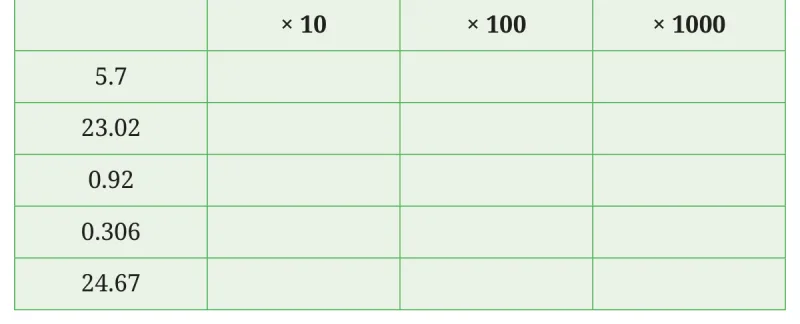
Multiplying the following numbers by 10, 100 and 1000 to complete the table.

A step-by-step solution for this question is coming soon.