In the Western Ghat region of Maharashtra, Keshav spends part of his summer vacation at his friend Jatin’s grandparents’ village. Having lived in a big city, he fi nds the forests, fresh air, sounds of gushing streams, and chirping birds a novel experience.However, for Keshav, the most fascinating sight is the dance of hundreds of fi refl ies at night, fl ashing their lights in a wonderful performance. Jatin’s grandparents explain that fi refl ies are seasonal insects and they use light to communicate. Unfortunately, Keshav also learns the number of fi refl ies is decreasing due to light pollution, reduced forest cover, and excessive tourism.At the end of their vacation, Keshav and Jatin board an evening bus back to their city. As the bus winds through the hilly roads, Keshav watches the moonlit landscape and the beams from the headlights of passing vehicles fl ashing by. He is reminded of the many poems and songs about moonlight, and wonders — does the Moon actually produce its own light? Did we not learn in the chapter ‘Beyond Earth’ in the Grade 6 Science textbook Curiosity that all other objects in our solar system shine only by refl ecting the light of the Sun? Is moonlight just refl ected sunlight? Which objects give off their own light? While thinking, he notices something strange — light seems to move in a straight line!
Chapter 153Chapter 1534/3/2025 4:56:22 PM4/3/2025 4:56:22 PMReprint 2026-27
11.1 Sources of Light
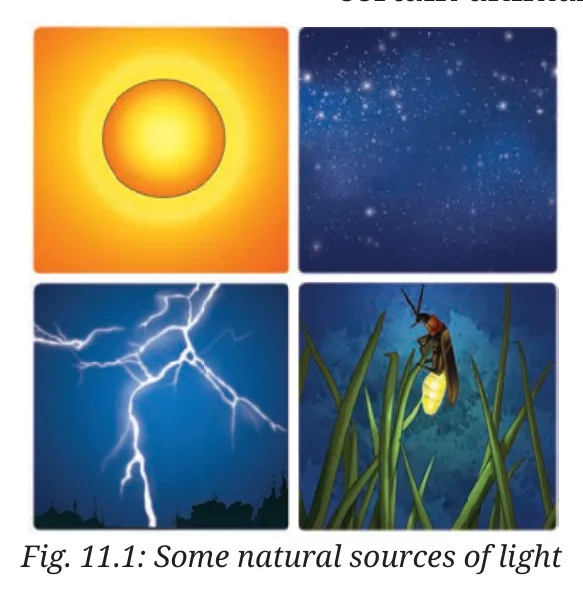
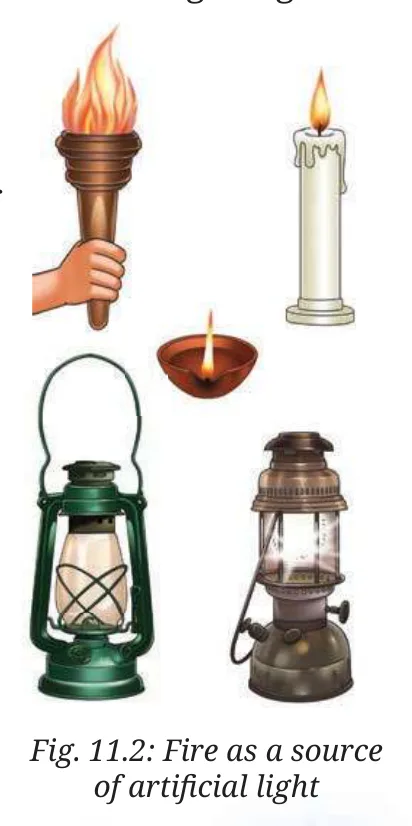
The Sun gives out or emits its own light and is the main source of natural light on the Earth. Stars, lightning, natural fi re, and certain animals also emit their own light (Fig. 11.1).In ancient times, humans learnt to create fi re — the earliest form of artifi cial lighting. With time, they learnt to create fi re using diff erent fuels, such as animal fat, oil, wax, and gas (Fig. 11.2). With the invention of electricity and diff erent kinds of electric light sources, most of the lighting needs of humans are now met by electric lighting (Fig. 11.3).Objects that emit their own light are called luminous objects. Objects that do not emit their own light are called non-luminous objects. The Moon is a non-luminous object. It does not emit its own light. It just refl ects the light emitted by the Sun that falls on it.
ob
object. It
ust refl ects the lig
at falls on it.
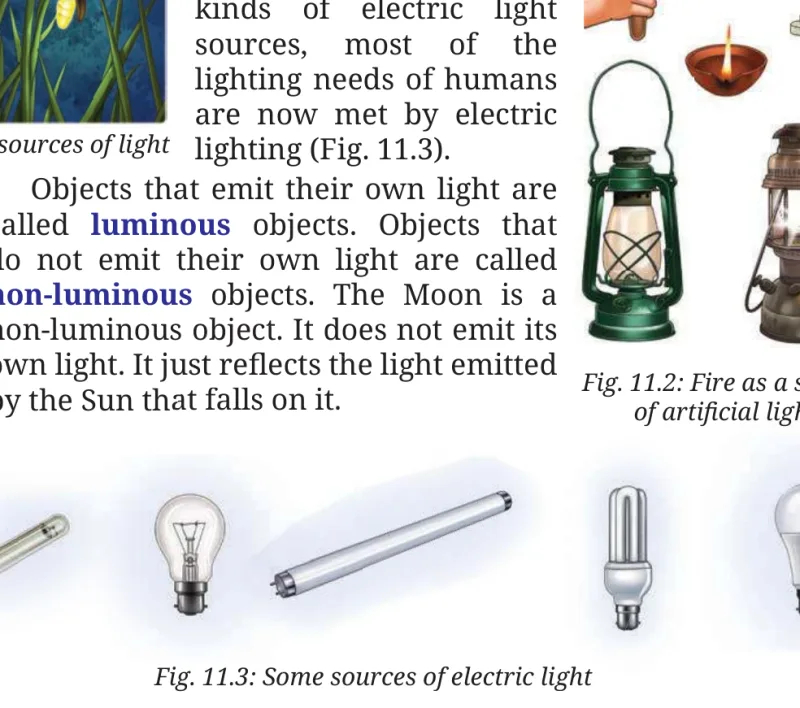
Some sources of electric lig
ght
SCIENCE AND SOCIETY
Light Emitting Diode (LED) lamps are modern light sources that consume much less power, are brighter and last longer than traditional lamps. This not only reduces electricity bills but is also better for environment. Recognising their advantages, the Indian government has made substantial eff orts to promote the use of LED lamps nationwide. At their end of life, LED lamps must be appropriately disposed or recycled, and not thrown in the garbage.
Chapter 154Chapter 1544/3/2025 4:56:26 PM4/3/2025 4:56:26 PMReprint 2026-27
11.2 Does Light Travel in a Straight Line?
Light: Shadows and Refl ections
Let us do an activity to try to fi nd out.
HoleScreen
Activity 11.1: Let us investigate
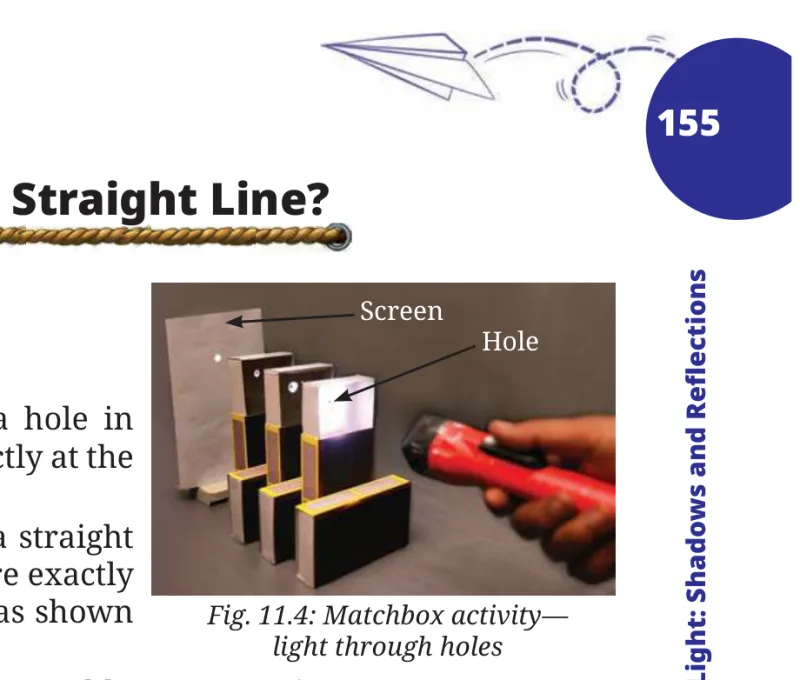
• Take three matchboxes and make a hole in the inner tray of each matchbox, exactly at the same position. • Arrange these three matchboxes in a straight line. Make sure that all three holes are exactly at the same height and are in a line as shown in Fig. 11.4. • Place a torch light on one side of the matchboxes, ensuring that its lamp is at the height of the holes. • Place a cardboard (screen) on the other side of the matchboxes and obtain a bright spot on it. (You may need to slightly adjust the heights of boxes.) • Move one of the matchboxes slightly to a side or up and down. Are you able to obtain the light spot on the screen now?When all the three holes are not in the same line, we could not obtain the light spot on the screen. These observations suggest that light travels in a straight line.
Can we somehow check it in some other way?
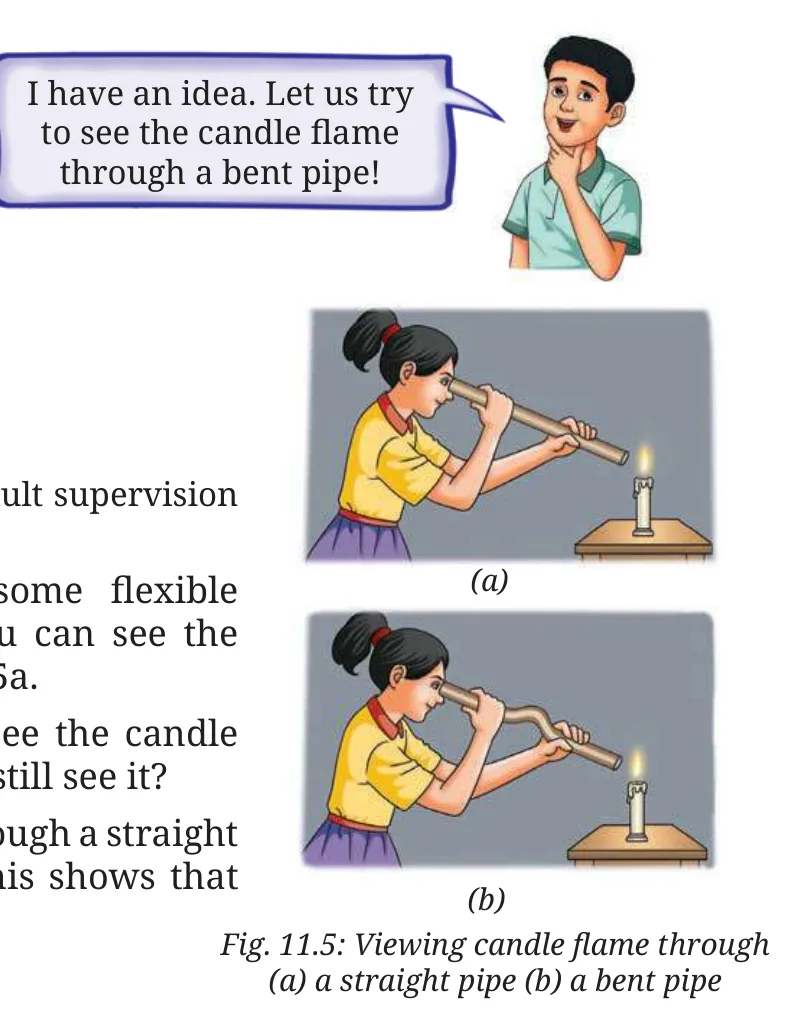
I have an idea. Let us try to see the candle fl ame through a bent pipe!
Should we also try out this idea?
Activity 11.2: Let us explore
Caution — Use a lighted candle under adult supervision only.
• Take a long hollow pipe of some fl exible material and align it so that you can see the candle fl ame as shown in Fig. 11.5a.
(a)
• Now, bend the pipe and try to see the candle fl ame again (Fig. 11.5b). Can you still see it?
You could see the candle fl ame through a straight pipe but not through a bent pipe. This shows that light travels in a straight line.
(b)
Chapter 155Chapter 1554/3/2025 4:56:28 PM4/3/2025 4:56:28 PMReprint 2026-27
Caution — Use a laser only under teachers’ supervision. Avoid using high-power lasers for this activity; a low-power laser pointer is suffi cient. Never point the laser beam directly at anyone’s eyes, as it can cause serious eye damage.
DIVEEEPER
Pass a laser beam through a beaker fi lled with water in which a drop of milk is added to make the laser beam easily visible. What do you observe? Do you see that the beam of laser light inside water follows a straight path? However, light can sometimes even bend around corners! This is something you will learn in the higher grades.
11.3 Light through Transparent, Translucent, and Opaque Materials
p q
Let us place objects made of diff erent materials in the path of light and fi nd out.
What happens when an object comes in the path of light?
Activity 11.3: Let us experiment
• Collect objects made of diff erent materials. Also, you will need a torch.
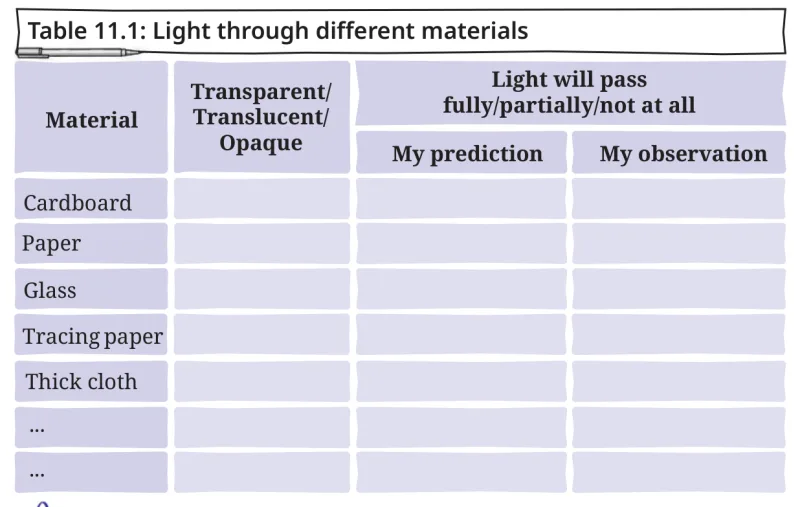
Light will pass fully/partially/not at all
Transparent/ Translucent/ OpaqueMy predictionMy observation
Material
Cardboard
Paper
Glass
Tracing paper
Thick cloth
...
...
Chapter 156Chapter 1564/3/2025 4:56:30 PM4/3/2025 4:56:30 PMReprint 2026-27
• List the materials of the objects in Table 11.1 and classify them into transparent, translucent, and opaque (In the chapter ‘Materials Around Us’ in the Grade 6 Science textbook Curiosityyou learnt to classify materials into transparent, translucent, and opaque, depending on how you could see through them). • Go to a dark room, turn on the torch, and place it at such a position that you get a spot of light from the torch on a wall. Or you may place a cardboard screen as shown in Fig. 11.6 and get the spot of light on it. • We will now conduct this activity in two parts — prediction and observation.
Light: Shadows and Refl ections
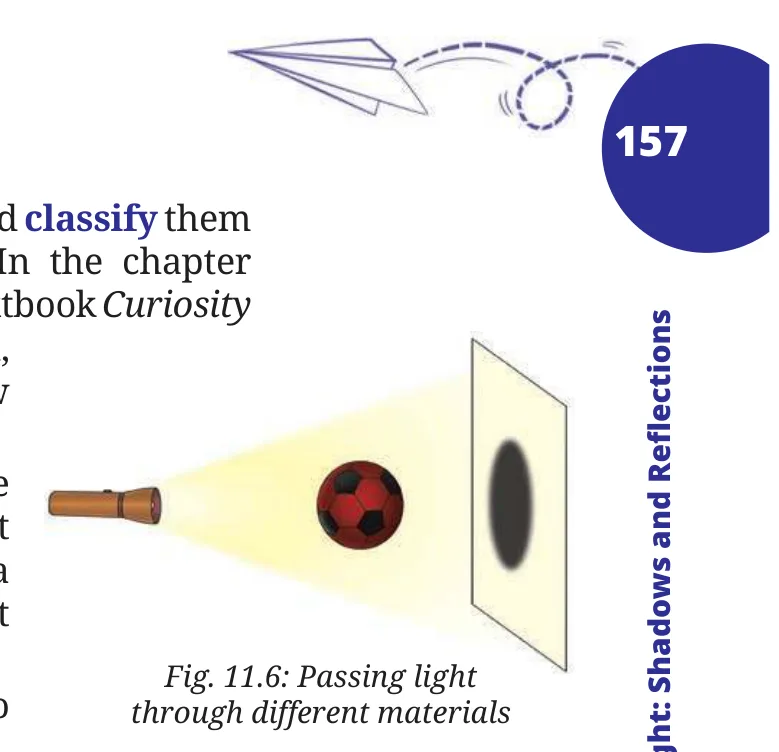
• Predict what will happen if you hold an object in front of the light coming out of the torch. Would you continue to see the spot of light on the screen? Note your prediction in Table 11.1.
• Now, actually place the object between the torch and the screen. Does light pass through the object? Note your observation in Table 11.1. • Repeat this for all the objects.Was your observation the same as your prediction? What conclusions could you draw? Light passes almost completely through transparent materials. Light passes partially through translucent materials. Light does not pass through opaquematerials.
What happens when an opaque object blocks the path of light?
Wha
opa
th
11.4 Shadow Formation
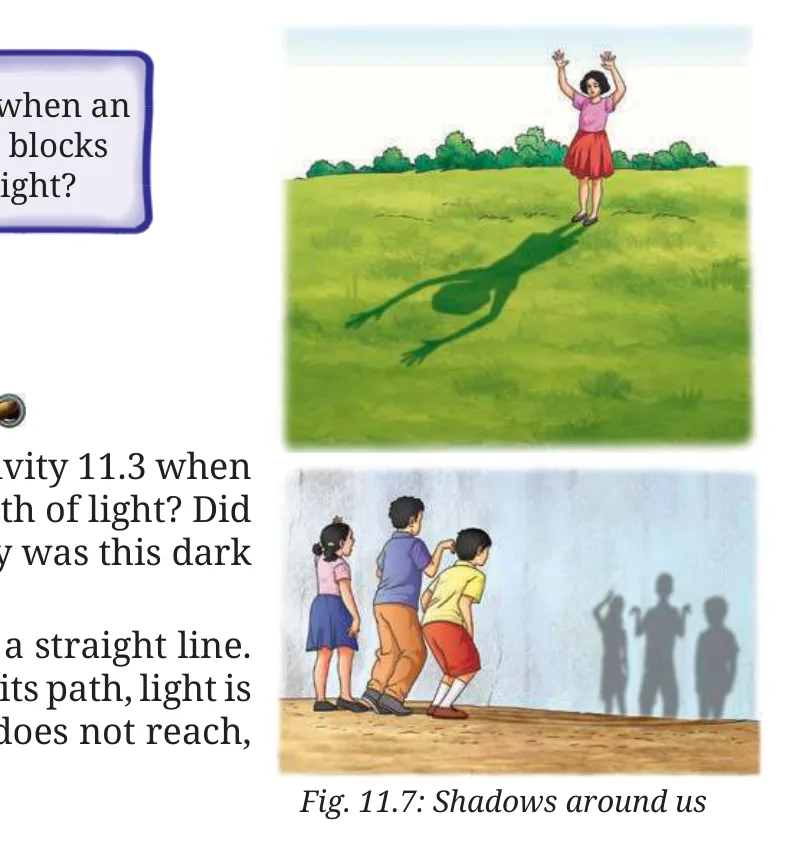
What did you see on the screen in Activity 11.3 when an opaque object was placed in the path of light? Did you see a dark patch on the wall? Why was this dark patch formed? We now know that light travels in a straight line. So, when an opaque object is placed in its path, light is blocked. The dark patch, where light does not reach, is the shadow.
Chapter 157Chapter 1574/3/2025 4:56:31 PM4/3/2025 4:56:31 PMReprint 2026-27
We have noticed shadows of ourselves and other objects around us when we are in the Sun or under a light (Fig. 11.7). Also, you might have had fun making diff erent shapes with shadows sometime. Do translucent and transparent objects create shadows or not? Did you notice that in Activity 11.3? Opaque objects form darker shadows. Translucent objects make lighter shadows. Even some transparent objects can create faint shadows!Let us learn more about shadows.
Activity 11.4: Let us explore
• Collect some opaque objects of diff erent shapes and sizes. • Repeat Activity 11.3, but this time, carry out the actions mentioned in the fi rst column of Table 11.2. • Observe the shape and size of the shadow on the screen for each of the actions. Did the shadow form in all cases? Was the shape and size of the shadow the same as the object? • Record your observations in the second column of Table 11.2.
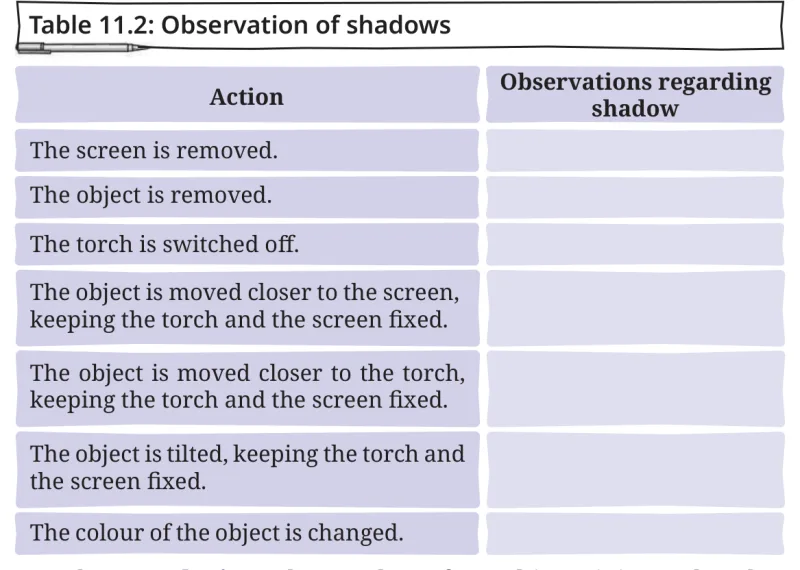
ActionObservations regarding shadow
The screen is removed.
The object is removed.
The torch is switched off .
The object is moved closer to the screen, keeping the torch and the screen fi xed.
The object is moved closer to the torch, keeping the torch and the screen fi xed.
The object is tilted, keeping the torch and the screen fi xed.
The colour of the object is changed.
What conclusions do you draw from this activity? What do we need to observe a shadow? Does the colour of the shadow change when the colour of the object is changed?Shadows are formed when an object blocks light from falling on a screen. We need a source of light, an opaque object, and a screen
Chapter 158Chapter 1584/3/2025 4:56:31 PM4/3/2025 4:56:31 PMReprint 2026-27
to observe a shadow. The walls, fl oor, ground, or any other surface acts as a screen for observing shadows in our daily life.The shape, size, and sharpness of the shadow depend on the position of the object relative to the light source and the screen. The shadows may give information about the object or we may not be able to guess the object at all. Changing the colour of opaque objects does not change the colour of the shadows.
Light: Shadows and Refl ections
FASCINATING FACTS
Shadow play, or shadow puppetry, has been a part of our cultural heritage for centuries. In this art form, fl at cut-out fi gures called shadow puppets are placed between a light source and a screen. By moving the puppets and the light, puppeteers can create life-like movements, bringing the characters to life. Diff erent regions have their own unique styles, like the Charma Bahuli Natya in Maharashtra, Keelu Bomme and Tholu Bommalata of Andhra Pradesh, Togalu Gombeyaatain Karnataka, Ravana Chhaya in Odisha, Tholpavakoothu in Kerala, and Bommalattam in Tamil Nadu. These are used not only for entertainment but also communicate important messages to the community.
11.5 Refl ection of Light
When the opaque object was a shiny object like a polished steel plate, I got a shadow on the screen, but I also saw that there was a bright spot of light on the wall on the opposite side. Why was it so?
Activity 11.5: Let us investigate
• Find a shiny fl at steel plate or a plane mirror, that is, a mirror that is fl at and not curved.
• Take it outside and let the sunlight fall on the shiny surface. What can you do to redirect light on the wall on which the sunlight is not falling directly?
Chapter 159Chapter 1594/3/2025 4:56:32 PM4/3/2025 4:56:32 PMReprint 2026-27
• Turn the shiny plate or mirror in diff erent directions to redirect the light onto a wall or a nearby surface (Fig. 11.8). Do you see a spot of light on the wall? Does it mean that the shiny plate or mirror has changed the direction of light?
• Now, tilt the shiny plate or mirror in diff erent ways and observe the light spot on the wall. Does it change position? Notice how light always travels in straight lines and changes direction when it falls on the shiny plate or mirror.
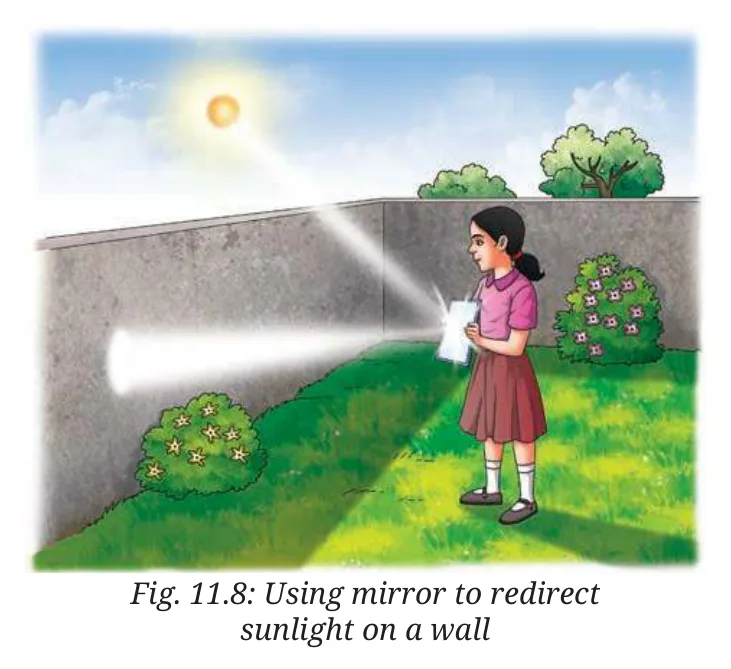
What conclusion do you draw from your observations? This activity suggests that a shiny surface or a mirror changes the direction of light that falls upon it. This change in direction of light by a mirror is called the refl ection of light. Let us try to understand the refl ection of light by a mirror.
Activity 11.6: Let us experiment
• Take a plane mirror with stand, a torch, a comb, a sheet of white paper, and a strip of black paper.
Thin slit
• Using the black paper, close all openings of the comb, except for one to make a thin slit.
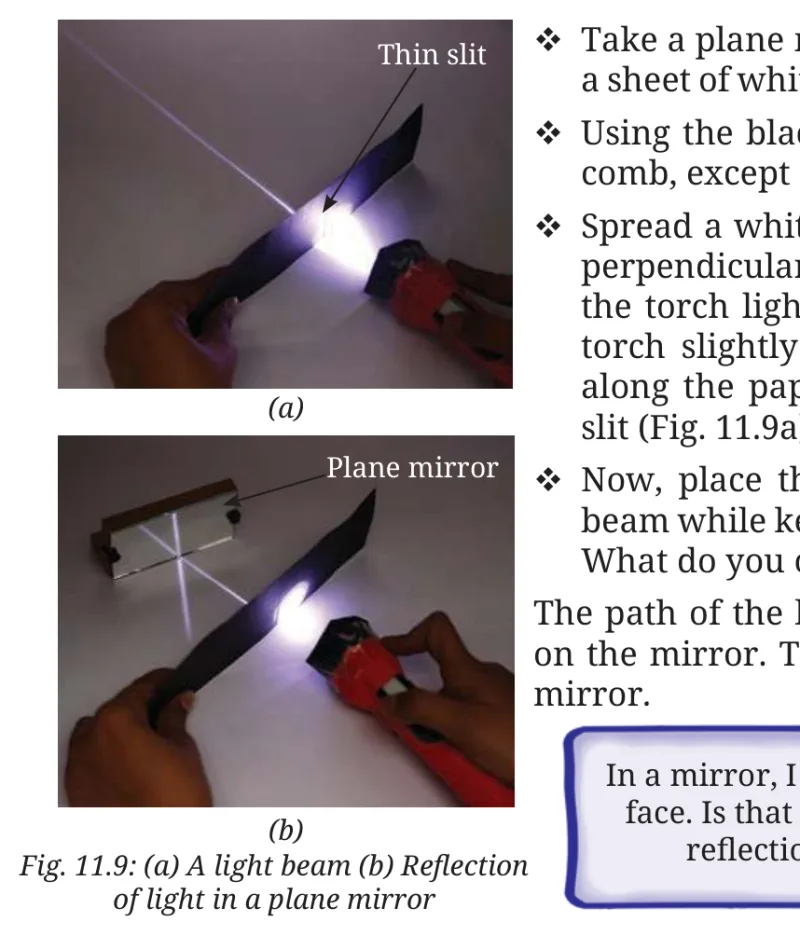
• Spread a white paper on a table, hold the comb perpendicular to the sheet of paper and shine the torch light on the slit. Adjust the comb and torch slightly till you see a thin beam of light along the paper which has passed through the slit (Fig. 11.9a).
(a)
Plane mirror
• Now, place the mirror in the path of the light beam while keeping the comb steady (Fig. 11.9b). What do you observe?
The path of the light beam is changed after falling on the mirror. The refl ection of light occurs at the mirror.
mirror.
In a mirror, I can also see my face. Is that also due to the refl ection of light?
(b)
Chapter 160Chapter 1604/3/2025 4:56:33 PM4/3/2025 4:56:33 PMReprint 2026-27
11.6 Images Formed in a Plane Mirror
Light: Shadows and Refl ections
Look into the mirror. Do you see your face in it? What you see is a refl ection of your face in the mirror. We also see refl ections of other objects that are in front of the mirror. Let us try to fi nd out more about this.
Activity 11.7: Let us experiment
• Take a plane mirror and a pen or some other object.
• Place the pen in front of the mirror as shown in Fig. 11.10.
What do you see in the mirror? It appears as if a similar pen is placed behind the mirror. The pen which appears behind the mirror is the image of the pen formed by the mirror. The pen itself is the object. • Now, move the pen to diff erent positions in front of the mirror and compare the sizes of the images of the pen at each position.
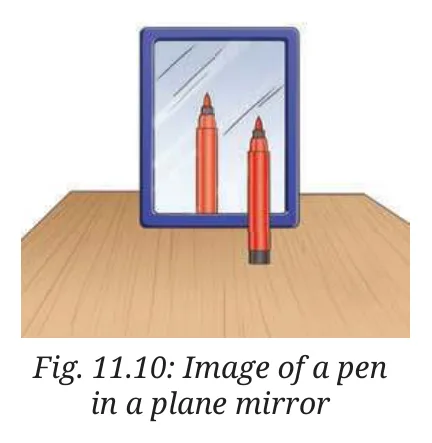
Are the two sizes the same? The image formed by a plane mirror is of the same size as the object. • Again, move the pen to diff erent positions in front of the mirror and observe if the image is upright at each position.
Does the tip of the pen appear on top at each position? An upright image is called erect. An image formed by a plane mirror is erect. • Now, place a screen vertically behind the mirror. Move it around. Do you get the image on the screen? Repeat this by placing the screen in front of the mirror.
The image formed by a plane mirror cannot be obtained on a screen.
Activity 11.8: Let us experiment
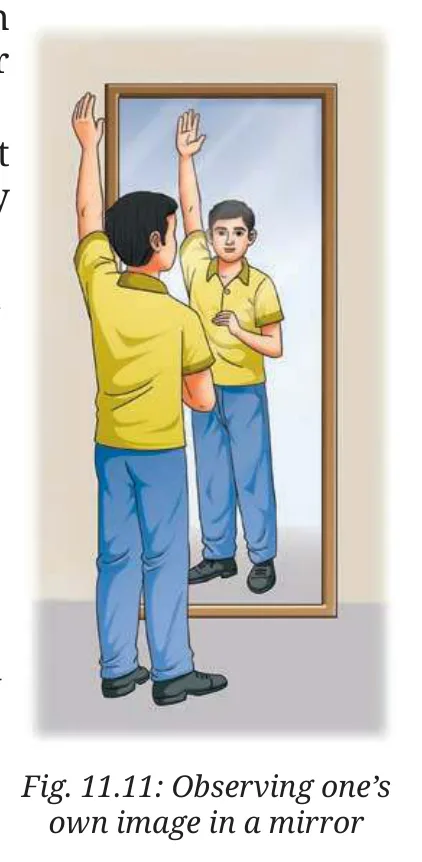
• Stand in front of a plane mirror and look at your image (Fig. 11.11). Notice how far it appears to be from the mirror. • Now, stand close to the mirror. Is the image also closer to the mirror? • Stand at diff erent distances from the mirror and notice how far the image appears to be from the mirror in each case. Do you fi nd any relation between your distance from the mirror and the distance of your image from the mirror?
Chapter 161Chapter 1614/3/2025 4:56:34 PM4/3/2025 4:56:34 PMReprint 2026-27
You might have noticed that when you stand close to the plane mirror, the image also appears to be close to the mirror. The image appears to be far from the mirror when you stand far from the plane mirror. • Raise your left arm. Which arm does your image raise?
• Touch your right ear. Which ear does your image touch?
You fi nd that your left appears right in your image and your right appears left in your image. This type of perceived left-right reversal is called lateral inversion. There is lateral inversion in the images formed by a plane mirror.
Oh! Now I realise why ‘̓ is written on an ambulance. It reads ‘AMBULANCE ̓ when viewed from the rear-view mirrors of the vehicle ahead of the ambulance.
FASCINATING FACTS
FASCI
When mirrors were invented is not known. Earlier, mirrors were made by polishing stone or metal. When glass mirrors started being made, the art of making metal mirrors got lost gradually. However, it still survives, for example, in Kerala, where Aranmula Kannadi, a unique metal surface mirror has been made for centuries.
When
were m
started
gradua
where
been m
Can we see an image of an object only in a mirror or are there some other ways as well?
11.7 Pinhole Camera
A pinhole camera is a device in which the light rays from an object pass through a tiny hole (a pinhole) and form an image on a screen.
Chapter 162Chapter 1624/3/2025 4:56:35 PM4/3/2025 4:56:35 PMReprint 2026-27
Activity 11.9: Let us explore
PinholeScreen
Caution — Use a lighted candle under adult supervision only.
Light: Shadows and Reflections
• Take a piece of cardboard and a candle. Make
Image
a small hole in the cardboard.
• In a dimly lit room, position the cardboard at
a short distance from a screen.
(a)
• Place a lighted candle in front of it as shown
in Fig. 11.12a.
What do you see on the screen? Light coming from the flame passes through the hole on the cardboard and forms an image of the candle flame on the screen. Do you notice anything surprising? The image of the candle flame is upside down, that is, inverted (Fig. 11.12b).Let us now make a pinhole camera, which you can use outdoors.
(b)
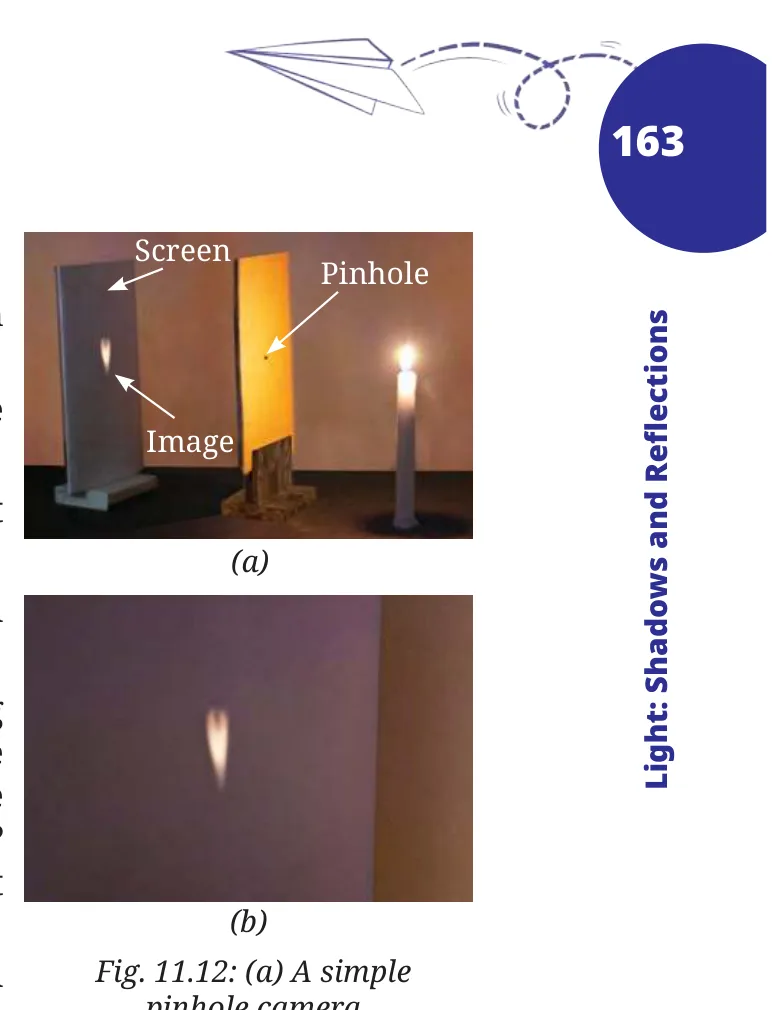
pinhole camera (b) Image of a candle flame
on screen
Activity 11.10: Let us construct
• Take two boxes of cardboard such that one can slide
into another with very little gap in between them. Cut open one side of each box.
Pinhole
• On the opposite face of the larger box, make a small
Open side
hole in the middle (Fig. 11.13a).
(a)
• On the opposite face of the smaller box, cut out a
square from the middle with a side of about 5–6 cm. Cover this opening with a thin translucent paper (like a tracing paper) to form a screen (Fig. 11.13b).
Screen
Open side
• Slide the smaller box inside the larger one in such
a way that the side with the tracing paper is inside (Fig. 11.13c).
(b)
Hold the pinhole camera with the pinhole facing the object and look through the open side of the smaller box. Cover your head and the camera with a dark cloth. Look at a distant object, like a tree or building, in bright sunlight and move the smaller box forward or backward until an image appears on the tracing paper.
Open side
(c)
Do the images seen in the camera show the colours of the objects on the other side? Are the images erect or upside down?
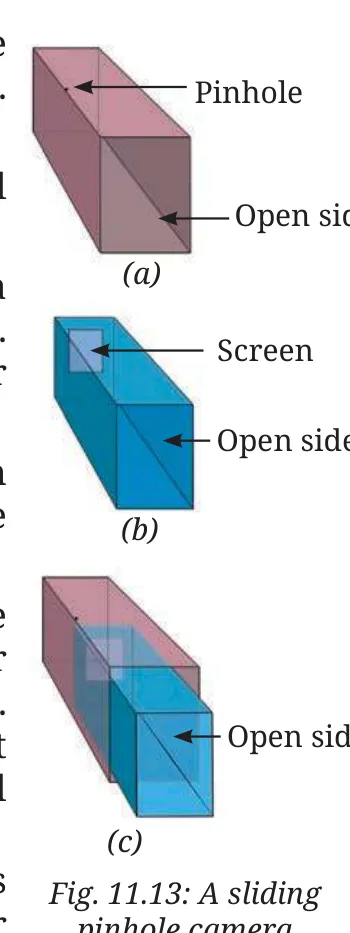
pinhole camera
Chapter 163Chapter 16316-09-2025 04:20:1316-09-2025 04:20:13Reprint 2026-27
DIVEEEPER
A pinhole camera gives an upside down image. On the other hand, there is lateral inversion in the image formed by a mirror but it is not upside down. We will learn more about this in higher grades.
A pin
ther
not u
11.8 Making Some Useful Items
11.8
After having learnt that light travels in a straight line and is refl ected by mirrors, it is time to create some useful items based on this learning.
11.8.1 Periscope
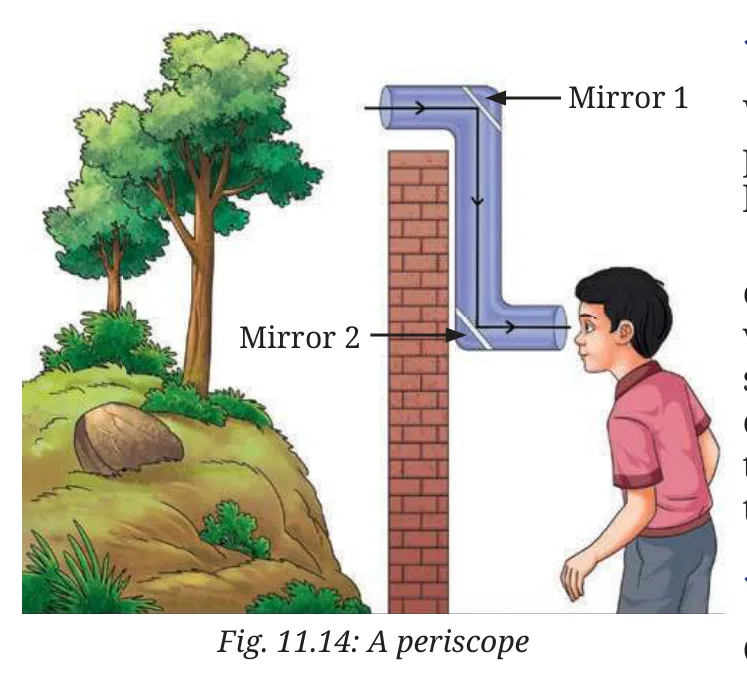
Mirror 1
We can make a simple periscope by placing two plane mirrors in a Z-shaped box as shown in Fig. 11.14.Refl ection from two mirrors enables us to see objects that are not visible directly. Periscopes are used in submarines, tanks, or by soldiers to see outside their bunkers. You may use it to look ahead when standing behind taller friends.
Mirror 2
11.8.2 Kaleidoscope
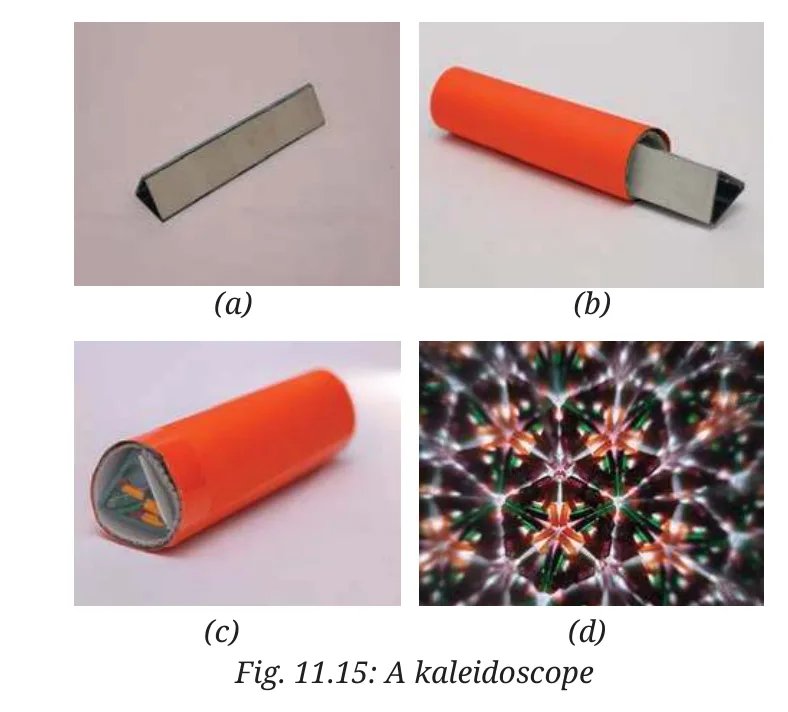
Get three rectangular plane mirror strips of equal width and join them together in a triangular manner as shown in Fig. 11.15a. You may use three strips of thick refl ective paper instead of mirrors. Fix these in a circular tube of thick chart paper (Fig. 11.15b). On one end of the tube, fi x a transparent plastic sheet using a rubber band or an adhesive tape. Place several broken pieces of coloured bangles or beads on this (Fig. 11.15c), and cover it with a tracing paper using a rubber band or an adhesive tape. When you peep through the open side, you view a beautiful pattern (Fig. 11.15d). Even if you leave both sides of the kaleidoscope open and
(a)(b)
(c)(d)
Chapter 164Chapter 1644/3/2025 4:56:38 PM4/3/2025 4:56:38 PMReprint 2026-27
point it towards a tree or other objects, you see beautiful patterns. An interesting feature of the kaleidoscope is that one always gets to see a diff erent pattern every time the kaleidoscope is turned about. Since there are 3 mirrors, and multiple images (due to refl ections of refl ections), many interesting patterns are formed. Designers and artists often use kaleidoscopes to get ideas for new patterns.
Light: Shadows and Refl ections
In a Nutshell
• Objects that emit their own light are called luminous objects.
• Light travels in a straight line.
• Light passes almost completely through transparent materials. Light passes partially through translucent materials. Light does not pass through opaque materials.
• A shadow is formed when light is blocked by an object. Opaque objects form darker shadows. Translucent objects make lighter shadows. Some transparent objects can create faint shadows.
• The change in the direction of light by a mirror is called refl ection of light.
• The image formed by a plane mirror is of the same size as the object, is erect, cannot be obtained on a screen, and is laterally inverted.
• A pinhole camera creates an inverted image of an object on a screen.
ENQUIRY