I placed a cube of ice here half an hour ago. It has now become water!
A bud that I saw yesterday on this rose plant has become a fl ower today.
ye
pl
fl o
The bottle containing cold water is not cold anymore.
Th
col
any
Yesterday, I saw some brown spots on a banana, but today it has more brown spots and a strong smell.
These students are describing some changes. What kinds of changes are they talking about?
Activity 5.1: Let us think and refl ect
You might have observed various changes happening around you. Some of them are listed in Table 5.1, you may notice that something is changing in each case. Take a moment to refl ect on the changes in each case. Record your observations in Table 5.1.
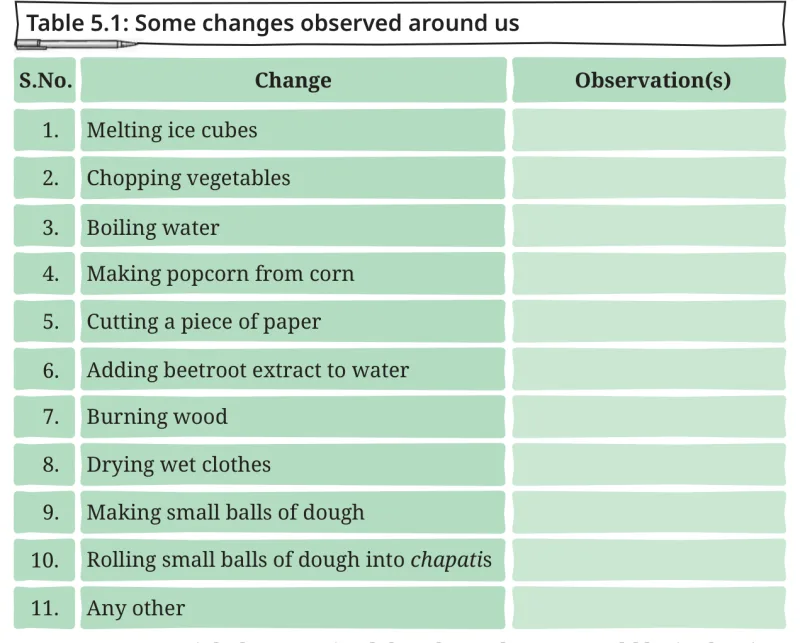
ChangeS.No.
Observation(s)
Melting ice cubes1.
2.
Chopping vegetables
3.
Boiling water
Making popcorn from corn4.
5.
Cutting a piece of paper
6.
Adding beetroot extract to water
7.
Burning wood
Drying wet clothes 8.
9.
Making small balls of dough
10.
Rolling small balls of dough into chapatis
11.
Any other
You might have noticed that these changes could be in the size, shape, smell, or other property of the substance or object. Can you think of some other changes that happen in your surroundings? Make a list of those changes too. We observe the changes occurring around us with the help of our senses of sight, smell, touch, hearing, and taste.
Can we arrange these changes into categories?
Let us try to answer this question.
5.1 A Substance May Change in Appearance but Remain the Same!
pp
Activity 5.2: Let us create and discuss
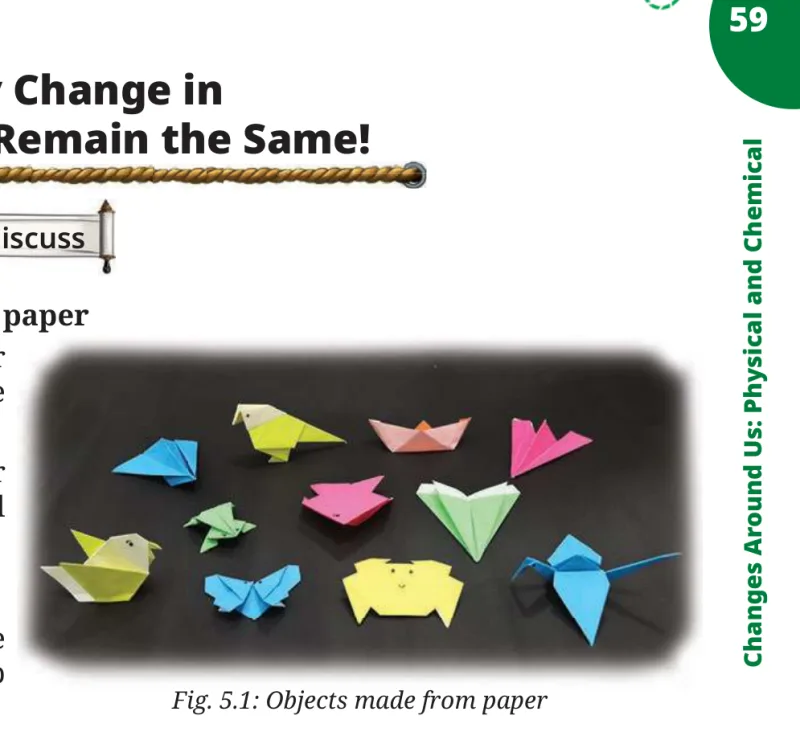
A. Creating some objects with paper • Take a few sheets of paper and fold them to create new objects (Fig. 5.1).
• Do you get the same paper back when you unfold these objects?
B. Playing with a balloon • Take a balloon and infl ate it. Now, loosen your grip and let the air escape out.
• Do you get the uninfl ated balloon back?
• Take another balloon; infl ate it and grip the opening tightly. Now, prick it with a pin.
Caution — Be careful while using a pin.
• What happens? Will you be able to get the uninfl ated balloon back?
C. Crushing a piece of chalk • Crush a small piece of chalk into powder.
• Can you get the chalk piece back from the powder?
Is there any similarity in the changes listed in A, B, and C?During all these changes, materials, such as the paper, the rubber sheet of the balloon, and the chalk, remained the same, though their appearances (shape or size) may have changed. You may also recall from the Grade 6 Science textbook Curiosity that water can exist in diff erent states (solid, liquid, and gas), and can change from one state to another. In all these cases, although we observe a change in the appearance, no new substance is formed. Such changes in which only physical properties like shape, size, and state of substances change are called physical changes. Let us explore a diff erent type of change.
5.2 A Substance May Change in Appearance and Not Remain the Same!
Activity 5.3: Let us explore
• Take two glass tumblers or small transparent bottles. Mark them A and B.
• Fill one-fourth of glass tumbler A with tap water and one-fourth of glass tumbler B with lime water.
• Now, blow air (exhale) into each glass tumbler, one at a time, using separate straws (Fig. 5.2) and observe them.
Caution — Do not suck the water or lime water while doing this.
(a)
(b)
StrawStraw
Glass tumbler containing lime water
AB
Glass tumbler containing tap water
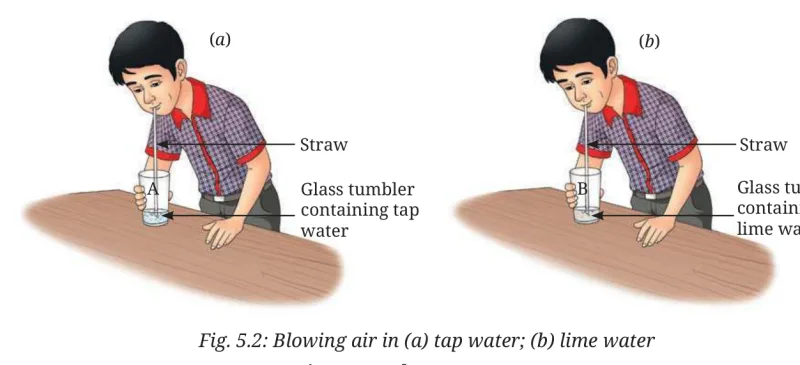
Do you notice any changes? In glass tumbler A, blowing air into water creates bubbles only, and there is no change in the appearance of the water. In glass tumbler B, blowing air into lime water creates bubbles, and turns the lime water milky (or cloudy). If we leave it for some time, a white substance settles at the bottom of the glass tumbler, indicating something new has formed. Such changes, in which one or more new substances are formed, are called chemical changes. New substances are formed through a process called chemical reaction. In this case, carbon dioxide from the air you breathe out (exhale) reacts with lime water, and forms a new white-coloured substance (calcium carbonate) that is insoluble in water. Therefore, the liquid in the bottle appears milky. Along with this a small amount of water is also formed. This formation of a new substance indicates a chemical change. The chemical reaction involved in this change can be represented in short form as a chemical equation.
Calcium hydroxide + Carbon dioxide Calcium carbonate + Water (Lime water) (Insoluble substance)The turning of lime water milky is also used as a test for carbon dioxide. Let us explore this with another activity using some substances from our kitchen.
Activity 5.4: Let us experiment
• Take a teaspoonful of vinegar or lemon juice in a test tube. • Add a pinch of baking soda (sodium hydrogen carbonate) to it. • What do you observe? • You would hear a fi zzing bubbling sound and see the gas bubbles forming. • Pass this gas through freshly prepared lime water kept in another test tube, as shown in Fig. 5.3a. • What do you observe? • The lime water turns milky. What do you infer about the gas formed by mixing vinegar and baking soda?This indicates that the gas formed is carbon dioxide.This activity can also be performed using two small used bottles instead of test tubes and a fl exible straw, as shown in Fig. 5.3b.
Lime water
Bubbles of carbon dioxide gas
as
Vinegar and baking soda(a)(b)
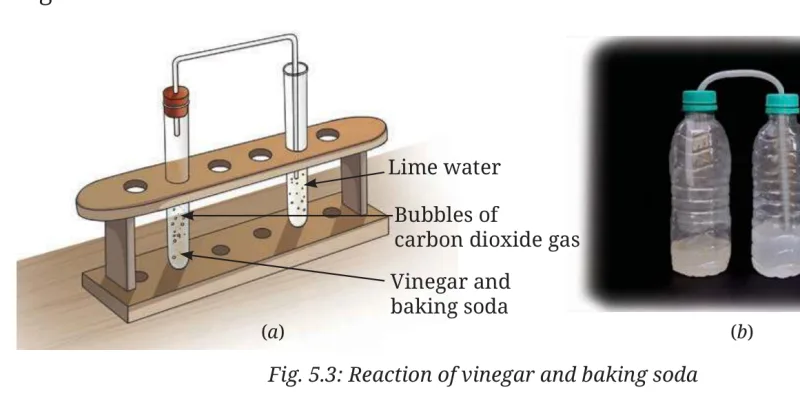
Since a new substance, carbon dioxide, is formed in this reaction, we say that a chemical change has occurred here as well. It can be represented as—Vinegar + Baking soda Carbon dioxide + Other substancesRepeat the above activity using baking soda and water. Do you observe any bubble formation? Is this a physical or a chemical change?
5.3 Some Other Processes Involving Chemical Changes
5.3.1 Rusting
In the rusting of iron, which you studied in the chapter ‘The World of Metals and Non-metals’, a new brown-coloured substance called rust is formed. Thus, rusting is also a chemical change because it involves the formation of a new substance, iron oxide (Fig. 5.4).
5.3.2 Combustion
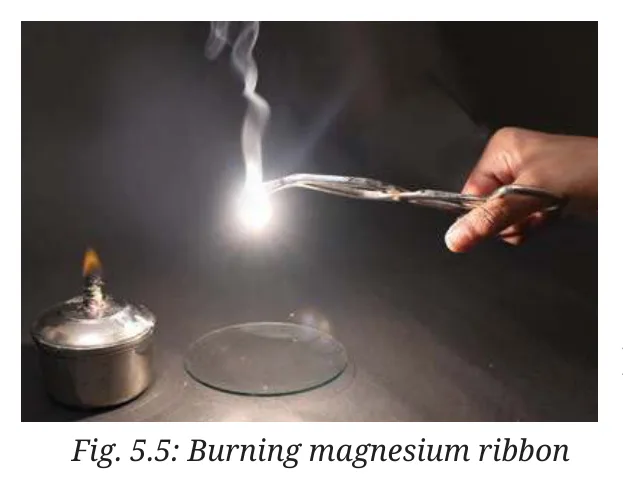
Let us recall the burning of a magnesium ribbon (Fig. 5.5) learnt in the chapter ‘The World of Metals and Non-metals’. Can you predict if this is a physical or a chemical change?When the magnesium ribbon is burnt, a new substance, magnesium oxide, is formed. So, the burning of magnesium ribbon also involves a chemical change. We observed that heat and light are also produced along with the formation of a new substance in this reaction.The burning of magnesium ribbon can be represented as—Magnesium + Oxygen Magnesium oxide + Heat + Light (Ribbon) (Air) (White powder)A chemical reaction in which a substance reacts with oxygen and produces heat and/or light is called combustion. Substances that undergo combustion reactions are called combustiblesubstances. For example, wood, paper, cotton, kerosene, etc., are combustible substances.
Let us fi nd out whether the presence of oxygen is essential for combustion.
Activity 5.5: Let us investigate
• Place two identical candles on two separate petri dishes and light them.
• Cover one of these with a glass tumbler, as shown in Fig. 5.6.
(a)(b)
• What happens to the candle fl ames in the two cases?
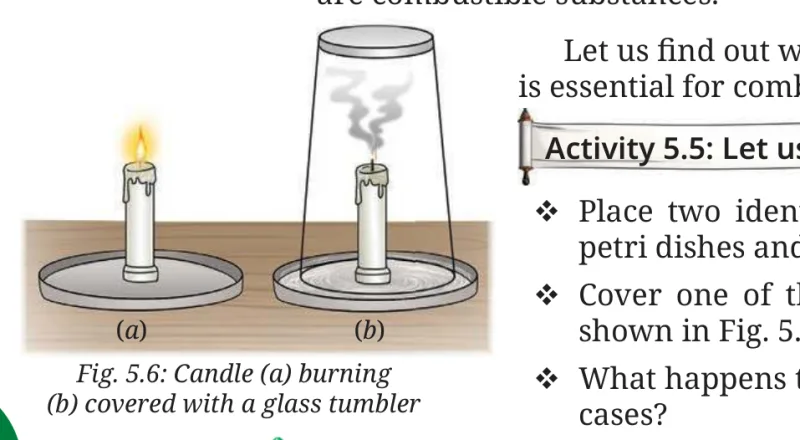
We observe that the candle that was not covered (Fig. 5.6a) continues to burn, whereas the candle that was covered with a glass tumbler (Fig. 5.6b) stops burning after some time. Why does this happen?Since the candle covered by the glass tumbler does not have a continuous supply of air, the fl ame gets extinguished soon. The component of air that supports combustion is oxygen. This can be confi rmed by the presence of carbon dioxide in the glass tumbler inverted on the candle. How can you test the presence of carbon dioxide gas? You can test the carbon dioxide gas by adding a small amount of lime water in the petri dish. You will notice that it turns milky. This carbon dioxide was formed by the carbon from the wax and the oxygen from the air. In other words, oxygen is required for combustion.
SCIENCE AND SOCIETY
If a person’s clothes catch fi re, what is the best way to extinguish the fi re?Wrap a blanket or cloth around the person. This cuts off the supply of air, and the fi re gets extinguished. Caution — Synthetic blanket or cloth should never be used to put out a fi re, as these can melt and stick to the skin.
FASCINATING FACTS
Nature’s wonders: You might have seen some insects emitting light in a garden or a fi eld in late evenings. These insects are called fi refl ies, and their light is produced by a chemical change. This type of light production (without heat) in living organisms is called bioluminescence.Fireflies
Fireflies
Is the Presence of Air Enough for Combustion?
We learnt above that combustible substances and oxygen are necessary for combustion. We also know that paper is a combustible substance, but we can keep it in the air for any length of time without it catching fi re. What else is needed to start combustion?Let us learn about this.
Activity 5.6: Let us investigate
Caution — Perform this activity under the supervision of your teacher or an adult.
• Hold a piece of paper with a pair of tongs and bring a lighted matchstick to it. It quickly catches fi re. Do we say that we need a fi re to start the burning process?
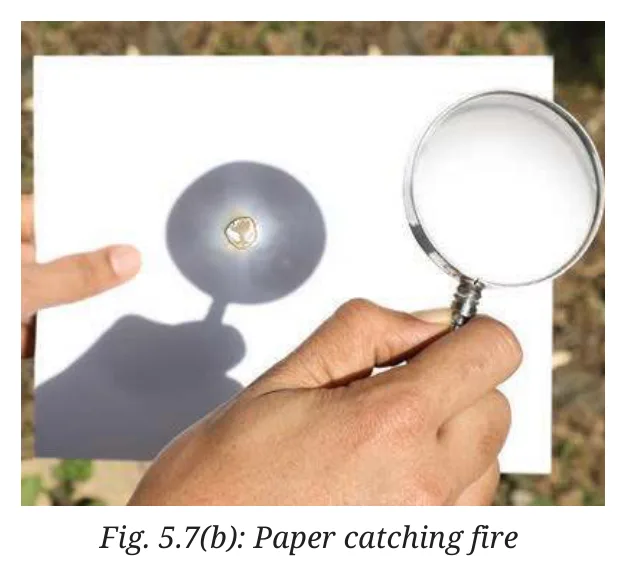
• Take another piece of paper. Using a magnifying glass, focus the sunrays to make the smallest and brightest spot on the paper, as shown in the Fig. 5.7a. Hold it there for some time.
What do you observe?We observe that the paper starts to emit smoke, and then catches fi re (Fig. 5.7b). Thus, we fi nd that a substance can burn even without fi re. How do we explain this change?Focusing sunrays on the paper heats it. The temperature of the paper increases with time. After some time, the paper becomes so hot that it starts burning. This minimum temperature at which a substance catches fi re is called its ignition temperature. Since the temperature of the lighted matchstick was already higher than the ignition temperature of the paper, it caught fi re almost immediately.
Fig. 5.7(a): Focusing the sunrays using a magnifying glass
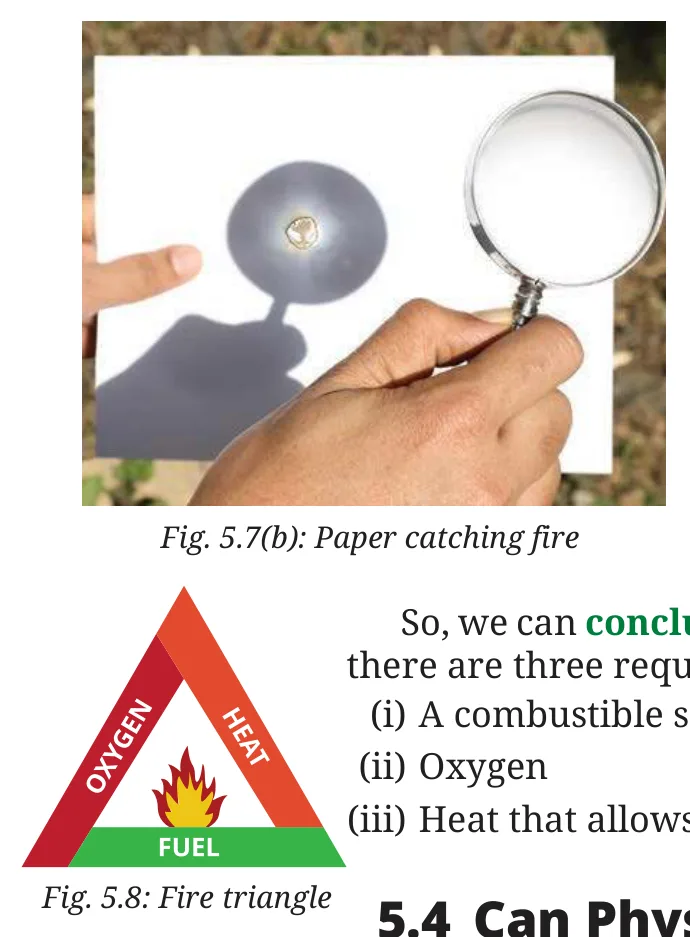
So, we can conclude that for the combustion process to occur, there are three requirements (Fig. 5.8) —(i) A combustible substance, also called ‘fuel’(ii) Oxygen(iii) Heat that allows the fuel to reach its ignition temperature.
5.4 Can Physical and Chemical Changes Occur in the Same Process?
What changes take place when a candle is lit? Let us explore!
Activity 5.7: Think, pair, and share
Look at the Fig. 5.9. Analyse what students are discussing about the burning candle. What do you think?
The wax melts and evaporates...
Wax melts, fl ows, and solidifi es in diff erent shapes...
I think the wax burns, and new substances are formed…
Maybe...
Maybe the wick draws up the liquid wax…
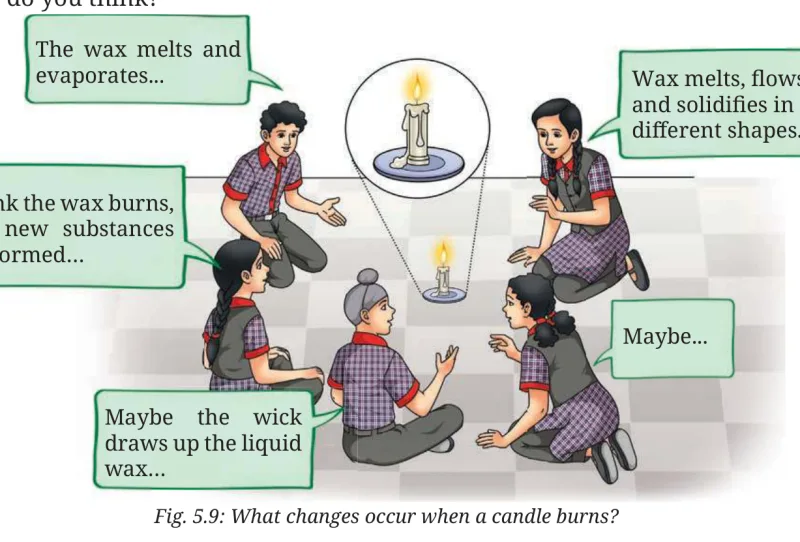
The wax of the candle melts, is carried up the wick, and evaporates due to the heat of the fl ame. The vapour of wax burns to produce a fl ame. The melting of wax, its solidifi cation, and evaporation are physical changes. The burning of vapour on the other hand, is a chemical change. This shows that the burning of a candle involves both physical and chemical changes.
KNOW A SCIENTIST
The candle you just observed has long been an object of curiosity for several scientists including Michael Faraday, who made signifi cant contributions to several areas of science. In the nineteenth century, Faraday delivered a series of lectures called Chemical History of a Candle. Faraday believed that the candle was the perfect object to introduce scientifi c study. Through it, he discussed diff erences between various physical and chemical processes like melting, vapourisation, and combustion.
5.5 Are Changes Permanent?
Once something has undergone a change, can we get it back in its original form?
Activity 5.8: Let us think
Think again about all the changes that we have discussed or talked about so far. In which of these can we get back the object or substance in the form we started with? Record your observations in Table 5.2.
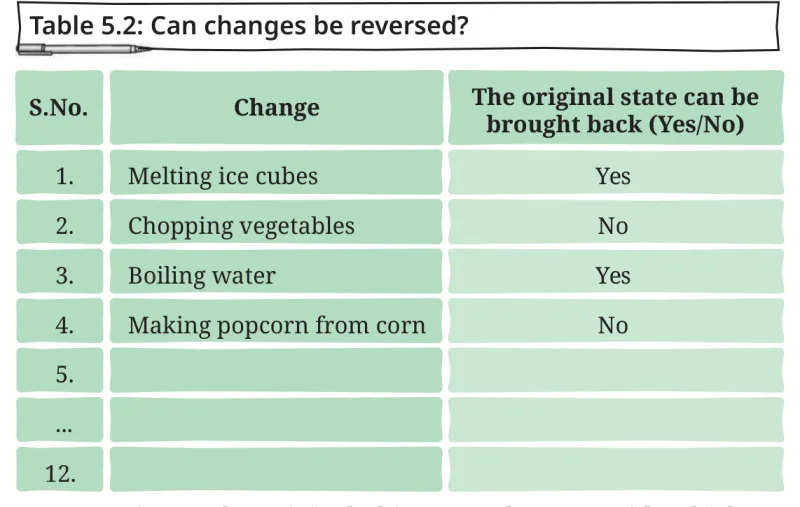
The original state can be brought back (Yes/No)
ChangeS.No.
Melting ice cubes1.
Yes
2.
Chopping vegetables
No
3.
Boiling water
Yes
4.Making popcorn from cornNo
5.
...
12.
Returning to the original object or substance with which we started shows that the changes we brought can be reversed. For example, when ice melts, it can be refrozen into ice. Similarly, when water evaporates, it can be condensed back into liquid water. However, some changes cannot be reversed since we cannot get the original object or substance back after the change. For example, chopped vegetables cannot return to their original size and shape, and making popcorn cannot go back to its original form. Thus, changes around us could be grouped into those that can be reversed and those that cannot be reversed.
5.6 Are All Changes Desirable?
Many useful changes happen in our daily life. For example, the changing of milk into curd, ripening of fruits, cutting of fruits, and cooking of food. All these are desirable changes. Can you think of some other desirable changes happening around you?
On the other hand, some changes may be undesirable, such as the rusting of iron or the decay of food during its storage. A change that is undesirable in some situations may be desirable in other situations. For example, decomposition of food can be very useful in converting food waste into compost.Some changes occurring over the years due to human activity can have a long-term environmental impact. For example, the increased consumption of fuels in cars, trains, aeroplanes, etc., is increasing the amount of carbon dioxide in the atmosphere. Drying of paint on walls, doors, furniture, etc., releases many substances through evaporation, causing atmospheric pollution.
5.7 Some Slow Natural Changes
5.7.1 Weathering of rocks
Have you seen heaps of sand, soil, and stones lying at the base of mountains as shown in Fig. 5.10a? These are called sediments. How have these formed? These are formed by physical changes that break up large rocks into smaller pieces. Temperature changes due to climatic conditions, growing roots of trees, and even freezing of water within cracks in the rocks can cause them to break.Water or chemicals present in water, can also react with the rocks and cause chemical changes in their composition. An example of such a chemical change is shown in Fig. 5.10b. Here, an originally black-coloured rock called basalt, which contains iron, has chemically changed to produce a red-coloured layer. The red colour is a result of the iron oxide produced when the rock surface was exposed for a long time to water or air containing water vapour. These physical and chemical changes in rocks are collectively called weathering, which eventually leads to the formation of soil.
(a)(b)Fig. 5.10: (a) Sediments at the base of a cliff (b) red sediment layer
5.7.2 Erosion
Have you noticed fi ne sand collecting on riverbeds or in lakes? This sand is formed when rock pebbles, soil, and sediments are broken down and moved from one location to another by natural forces like wind and fl owing water. This process is called erosion.Erosion during a landslide is an example of a physical change. River rocks and pebbles often appear smoother due to the constant erosion caused by the fl owing water. When the speed of the water or wind decreases, such as in an ocean or a lake, the material transported during erosion settles down at the bottom. These sediments harden over time and become new rocks. Most of these changes take place over thousands of years and cannot be reversed.
In a Nutshell
• A physical change is one in which a substance or object undergoes a change in its physical properties and no new substance is formed.
• A chemical change is one in which one or more new substances are formed. It involves a chemical reaction and can be represented by a chemical equation.
• Combustion, cooking, and rusting are examples of chemical changes.
• Substances that undergo combustion are combustible substances. Heat and/or light are given out during combustion.
• The lowest temperature at which a substance can catch fi re is called its ignition temperature.
• Some changes can be reversed and some cannot.
• Some changes are desirable and some are not.
• Rocks undergo physical and chemical changes due to weathering to form soil.
• Erosion caused by fl owing water and wind is a physical change.