Pema and her brother Palden reside in Gangtok. On a cold winter evening, they are sitting around a fi replace. Palden shares his experiences of visiting Kerala during the winter vacation. He says that compared to Gangtok, winter in Kerala is comparatively warm and humid. Both Pema and Palden are curious about why some places are so cold and others quite hot. Hearing them express their curiosity, their grandfather, a retired science teacher, says, “Kerala is closer to the equator than Sikkim and it also has a long coastline, which results in warmer and more humid weather conditions”. Palden replies, “Yes, we learnt in Grade 6 Science and Social Science that for us on the Earth, the Sun is the main source of heat and light, and around the equator, the climate is generally hot”. As they are talking, Pema is keenly observing her grandmother cooking thukpa (a traditional Sikkimese dish) in a large metal pan. Pema asks, “Why are cooking utensils generally made of metals?” Palden immediately responds that they had studied in the chapter ‘The World of Metals and Non-metals’ that such materials are good conductors of heat.
How does heat get transferred in these materials?
Let us perform an activity to learn why certain materials are good conductors of heat.
7.1 Conduction of Heat
Activity 7.1: Let us experiment
Caution — This activity should be carried out under the supervision of a teacher or an adult.
• Take a strip of a metal, such as aluminium or iron, about 15 cm long.
Metal strip
StandPin
• Attach four pins to the strip with the help of wax such that they are arranged at nearly equal distances (about 2 cm apart), as shown in Fig. 7.1.
• Secure the strip to a stand and label the pins as I, II, III, and IV, as shown in Fig. 7.1. (If a stand is not available, place the strip between two bricks for support.)
Burning candle
• Heat the end of the strip that is away from the stand with a candle or a spirit lamp.
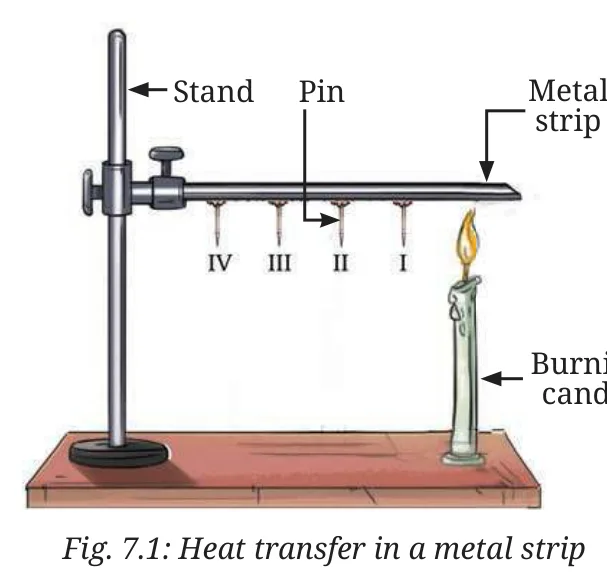
• What will happen to the pins? Will they remain attached to the strip or will they fall?
• Predict the order in which the pins will fall from the strip.
• Record your observations in Table 7.1.
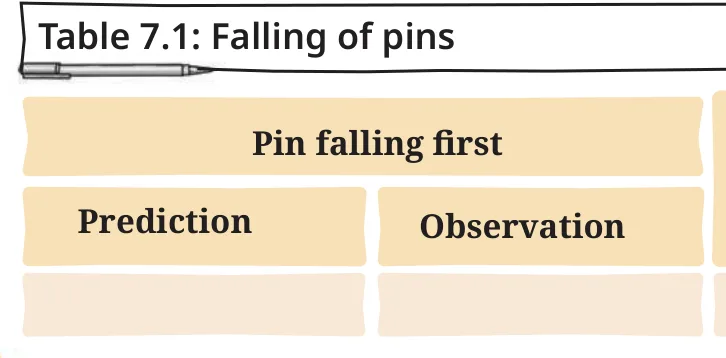
Pin falling fi rst
Reasons for what you observedPrediction Observation
You observed that the pin closest to the candle fl ame (pin I) falls fi rst, followed by pins II, III, and IV. Why does pin I fall before pin II? Why did all the pins not fall together? From your observations, what can you infer? Do you think that heat is being transferred along the metal strip from the end that is being heated? As the heat travels along the strip and approaches a pin, the wax holding it melts and the pin falls. Here, the transfer of heat takes place from the hot end of the strip to the colder end. The process of heat transfer from the hotter part of an object to the colder part is called conduction. In this process, the particle that gets heated, passes the heat on to its neighbour, and so on. However, the particles themselves do not move from their positions. Materials like metals that allow heat to pass through them easily are called good conductors of heat. Because metals are good conductors of heat, we use utensils made of metals for cooking. In solids, heat transfer takes place mainly through the process of conduction.If we use a strip made of a material like wood or glass in place of a metal strip to perform Activity 7.1, the pins will not fall. Can you think of the reason for this based on our learning from the chapter ‘The World of Metals and Non-Metals’? Materials such as glass and wood do not allow heat to pass through them easily and are poor conductors (insulators) of heat. Clay and porcelain are also poor conductors of heat — that is why tea or coff ee kept in such cups stays hot longer.List some materials around you and classify them as good or poor conductors of heat in Table 7.2.
als ?
Now, I know, why we generally use metal utensils for cooking, whereas we prefer clay and porcelain cups for drinking tea or coff ee.
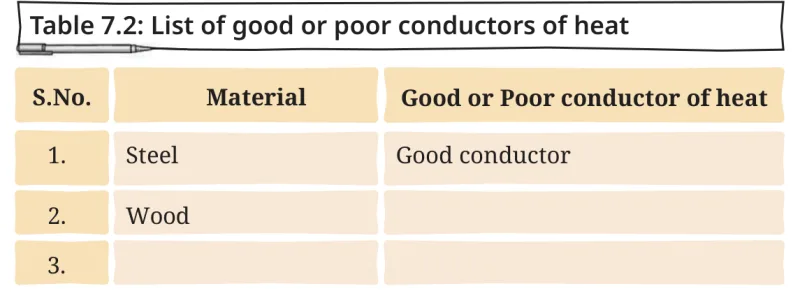
S.No.Material
Good or Poor conductor of heat
SteelGood conductor1.
2.Wood
3.
Does your list include air? If it is there on the list, where have you placed it? You must have experienced that during winters, we prefer wearing woollen clothes to keep ourselves warm.
Woollen fabric traps air in its pores and as air is a poor conductor of heat, it reduces heat flow from our bodies to our surroundings. As a result, we feel warm. Similarly, air trapped between the layers of clothing acts as a poor conductor of heat and keeps us warm. The presence of air between two thin blankets is the reason why we prefer them over one thick blanket to keep us warm (Fig. 7.2).Is it possible to construct houses that are not affected much by the outside heat and cold? Houses constructed in places with a very hot or cold climate often use the concept of heat transfer to keep them cool or warm.
Air
FASCINATING FACTS
The upper regions of the Himalayas, such as the Mori block of Uttarkashi in Uttarakhand, experience an extremely cold climate and heavy snowfall during winters. Houses here are often built to stay warm during winters, with walls made of two wooden layers filled with cow dung and mud between them. As wood and mud are poor conductors of heat, they prevent heat loss and help in keeping the houses warm.
There are houses with outer walls that are constructed using hollow bricks that keep them warm in winters and cool in summers. This happens because the air that gets trapped in the hollow bricks is a poor conductor of heat.Pema draws Palden’s attention to the rising smoke from the burning firewood, around which they are sitting.
Why is the smoke going up?
7.2 Convection
To understand why smoke rises, let us perform an activity.
Wooden stick
Activity 7.2: Let us investigate
• Take two identical paper cups.
Thread
• Hang them using threads of equal length in an inverted position on the two ends of a wooden stick, as shown in Fig. 7.3a.
Paper cup
Wooden stick
• Now, adjust the positions of the cups, so that the stick is horizontal.
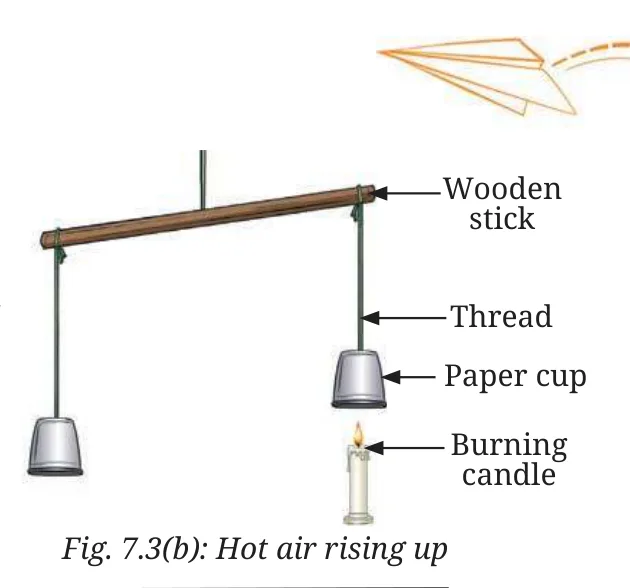
• Place a burning candle below one of the cups (Fig. 7.3b).
Thread
Paper cup
• Observe what happens to the cup.
Burning candle
• Record your observations in Table 7.3 and think of probable reasons.
Observation about the cupsProbable reasons for the observation
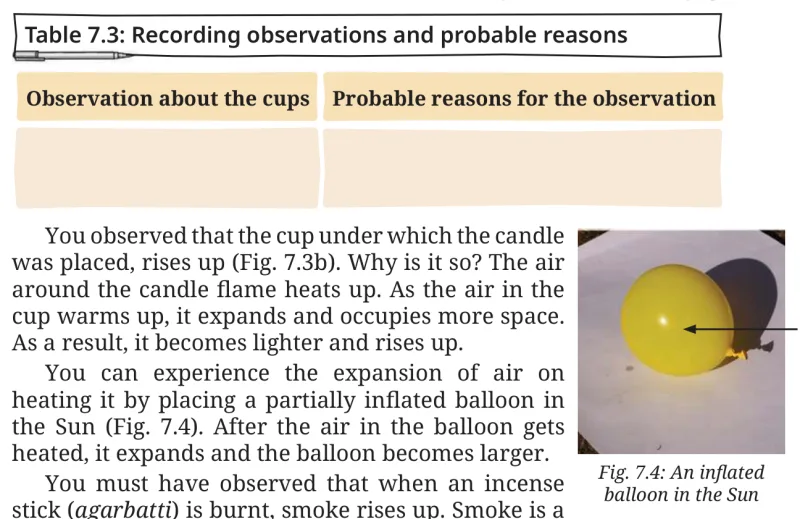
You observed that the cup under which the candle was placed, rises up (Fig. 7.3b). Why is it so? The air around the candle fl ame heats up. As the air in the cup warms up, it expands and occupies more space. As a result, it becomes lighter and rises up. You can experience the expansion of air on heating it by placing a partially infl ated balloon in the Sun (Fig. 7.4). After the air in the balloon gets heated, it expands and the balloon becomes larger. You must have observed that when an incense stick (agarbatti) is burnt, smoke rises up. Smoke is a mixture of hot gases and tiny solid particles that are released when something burns. As it is warmer than the surrounding air, it rises up.Let us fi nd out how heat transfer takes place in liquids by performing the following activity.
Infl ated balloon
How does heat transfer take place in liquids? Do liquids also rise up when heated like air?
Activity 7.3: Let us fi nd out
Caution— This activity should be carried out under the supervision of a teacher or an adult.
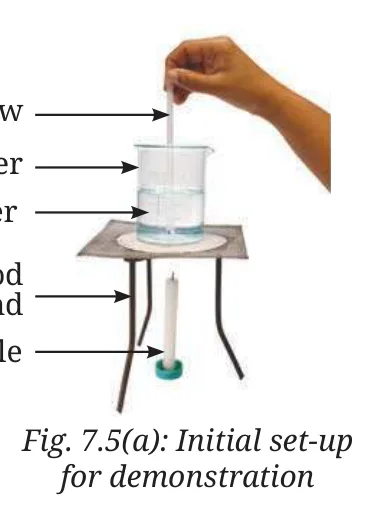
• Take a 500 mL beaker, half-fi lled with water as shown in Fig. 7.5a.
• With the help of a straw, place a grain of potassium permanganate at the centre of the beaker’s base (Fig. 7.5a).
• Place a candle right below the centre of the base of the beaker.
• Observe the movement of the coloured streak in the water.
Straw
• As you supply heat, a streak of colour starts moving up and then coming down from the sides (Fig. 7.5b).
Beaker
Water
Why does the streak of coloured water go up in the middle and come down from the sides? The water at the bottom of the beaker gets heated up and becomes hot. It expands, becomes lighter, and rises. The water on the sides of the beaker is comparatively cooler and heavier, and comes down to take the place of the rising water. Then, this water gets heated and in turn also rises.This cycle continues until the entire volume of water gets heated. In this case, the entire volume of water gets heated through the actual movement of water particles. This process of heat transfer is known as convection. It is because of convection that we see the movement of the coloured streak inside the beaker.Thus, we can conclude that water, like air, gets heated up by the process of convection. Here, heat transfer takes place by the actual movement of particles of liquids and gases from one place to another.
Tripod stand
Candle
Coloured streak
Burning candle
Fig. 7.5(b): Demonstration of convection in heated water
7.2.1 Land and Sea Breeze
Palden shares his experience of visiting a beach in Kerala during winter vacation and says, “During the day, the sand or soil near the beach is hotter than the water in the sea. However, at night, the sand or soil is cooler than the water.” Pema replies, “Yes, diff erent objects get heated and cooled diff erently.”
Let us check how land and water get heated and cooled by performing an activity.
Activity 7.4: Let us investigate
Caution— This activity should be carried out on a clear, sunny day under the supervision of a teacher or an adult.
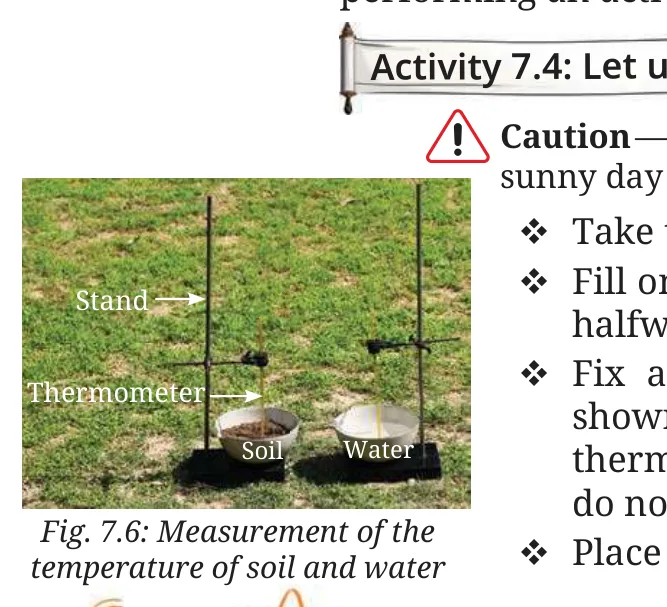
• Take two identical bowls as shown in Fig. 7.6. • Fill one bowl halfway with soil and the other bowl halfway with water. • Fix a laboratory thermometer in each bowl as shown in Fig. 7.6. Make sure that the bulbs of the thermometer are immersed in soil and water, and do not touch the bottoms or the sides of the bowls. • Place the set-up in sunlight.
Stand
Thermometer
Water
Soil
• Measure the temperature of soil and water every 5 minutes and record the data in Table 7.4.
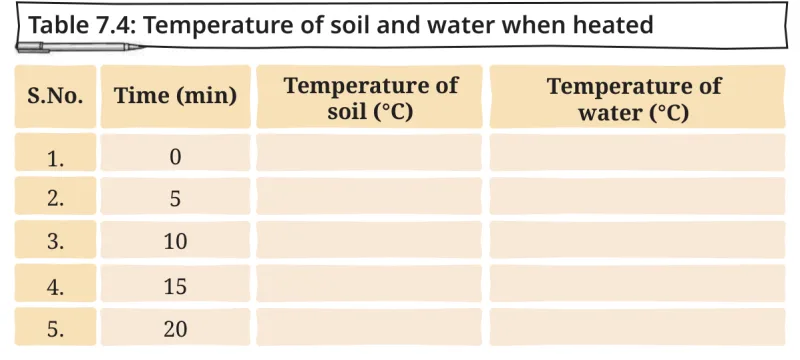
S.No.Temperature of soil (°C)Time (min)
Temperature of water (°C)
01.
2.
3.
4.
5.
• Study the rise in temperature of soil and water.
• Did the temperature rise by the same amount for both the soil and the water at the same time? • If not, which one got heated faster? • How much was the rise in temperature of the soil and the water in 20 minutes?After 20 minutes, you will fi nd that the temperature of the soil rises more than that of the water. This indicates that the soil heats up faster than water. Does the soil also cool faster than water? After letting the soil and water get heated, bring the set-up indoors and let it cool for 20 minutes. You will observe that the soil cools faster than water, just as it gets heated faster.People living in coastal areas experience an interesting phenomenon caused by the heating and cooling of land and water at diff erent rates. As the land gets heated faster than water during the day, it causes warm air above the land to rise. This causes cooler air to move from the sea towards the land. This movement of cooler air from the sea to the land is called sea breeze (Fig. 7.7a). Hence, in hot places, sea breeze relieves people from the heat. That is why, windows of the houses in coastal areas are placed facing the sea.
Warm air
Cool sea breezeWarmer land
Cooler sea
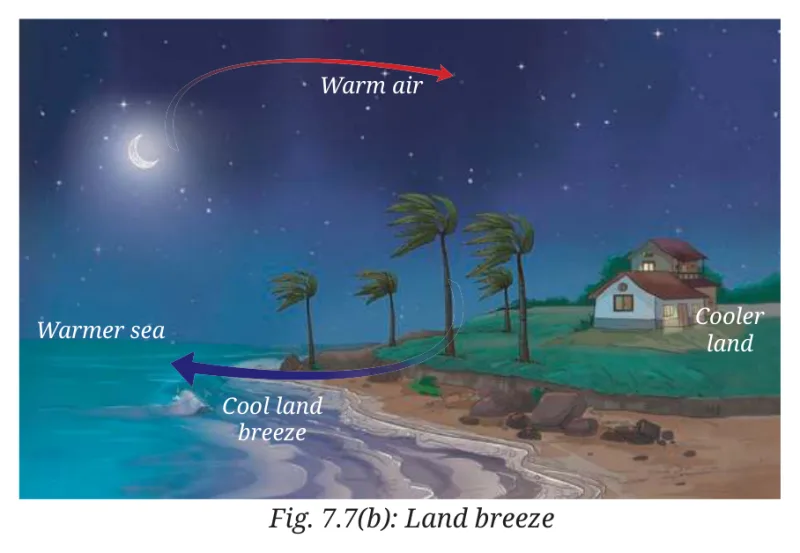
At night, the process reverses. In the absence of sunlight, land cools down faster than the water in the sea. As a result, the air above the sea is warmer and rises up. Cooler air from the land then moves towards the sea, creating a land breeze (Fig. 7.7b).Thus, people living near the seashore experience that the direction of the wind reverses in the day and night.
Warm air
Cooler land
Warmer sea
Cool land breeze
7.3 Radiation
Do you remember when Pema and Palden were sitting around the fi replace? They felt warm.Their grandfather tells them that the heat transfer, in this case, takes place directly from the fi re (hot object) to us by a process known as radiation. The heat of the Sun reaches us through this process. Heat transfer by radiation does not require any medium. All objects radiate heat. You must have observed that a hot utensil kept away from the fl ame cools down after some time. What is the reason for it? The hot utensil cools down by radiating heat to its surroundings.
I wonder how heat from the fi re reaches us?
DIVEEEPER
Why is it more comfortable to wear white or light-coloured clothes during summers and dark-coloured clothes during winters?
Light-coloured clothes refl ect most of the heat that falls on them, and therefore, we feel more comfortable wearing them during summers. Dark surfaces, on the other hand, absorb more heat, and therefore, we feel more comfortable with dark-coloured clothes during winters.
There are many examples in our daily life, where we can observe conduction, convection, and radiation happening together.Consider the case of water being heated up, as shown in Fig. 7.8. Let us identify the various ways in which the pan and the water get heated up, as well as the warmth we feel around the fl ame and the hot pan. Heat is transferred from the fl ame to the utensil by conduction. Subsequently, water in the utensil gets heated up by convection. The warmth that we feel around the fl ame and the hot utensil is due to radiation.Let us wrap up!From the activities, examples, and discussions so far, we fi nd that there are three processes by which heat gets transferred. These are conduction, convection, and radiation. • In conduction, heating takes place when one particle receives heat, transfers heat to the next particle in contact, and so on. The particles themselves do not move away from their positions. • In convection, heat transfer takes place by the actual movement of particles. • Note that in conduction and convection, a medium must be present whose particles help in the transfer of heat. • In the case of radiation, heat travels from one place to another and no material medium is required for its transfer.
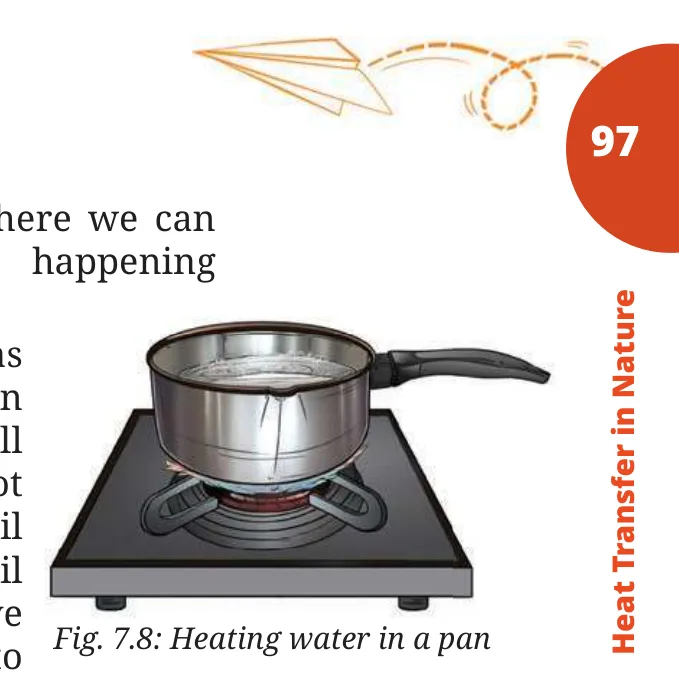
Fig 7 8: Heating water in a pan
FASCINATING FACTS
In the upper reaches of the Himalayan region, a traditional room heater locally known as bukhari is used to keep rooms warm during winters. It consists of an iron stove in which wood or charcoal is burnt. A long pipe attached to the upper part of the heater serves as a chimney, venting out the smoke. Additionally, the bukharican be used for cooking, as its fl at top provides a platform for placing utensils. All the three processes of heat transfer are involved when this device is used for cooking and warming up the room.
t.
of
ri
s.
Bukhari
You have learnt in the Grade 6 Science textbook Curiosity, that the Sun is the main source of heat for the Earth. You have seen your parents drying wet clothes on the clothesline at home. Wet clothes dry faster on a sunny day since the heat from the Sun makes the evaporation of water faster. Thus, heat from the Sun plays an important role in the evaporation of water, be it from clothes drying on a line or from water bodies like oceans and lakes. Let us look at the phenomenon of water cycle to understand this in more detail.
7.4 Water Cycle
You have also learnt in the Grade 6 Science textbook Curiosity, that water exists in three states in nature. As a liquid, it fi lls the oceans, rivers, and lakes on the Earth. As a solid, it forms snow, ice sheets, and glaciers in the mountains and the polar regions. As a gas, it exists in the form of water vapour in the Earth’s atmosphere. During summers, some of the snow and ice gets converted to water due to the Sun’s radiation and fl ows down as rivers, and ultimately into the oceans. The melted ice is replenished by fresh snow during winters. Water in the oceans, rivers, and lakes gets heated due to the Sun, and as a result, it evaporates as water vapour. Water also evaporates from trees and plants through transpiration. When water vapour rises up, it cools down and condenses to form clouds. Clouds bring rain, snow, and hail. This process is called precipitation.
Sun
CondensationPrecipitation
it
Transpiration
Evaporation
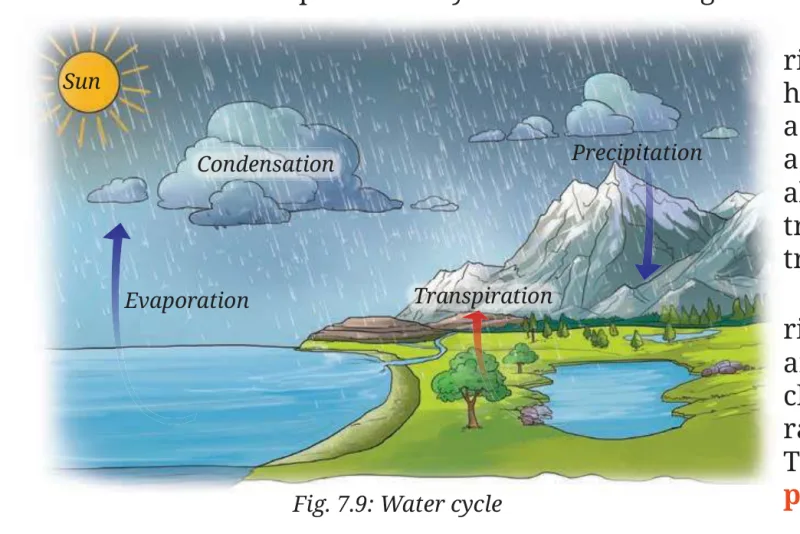
The continuous movement of water — upward as water vapour and downward through precipitation, passing through soil, rocks, and plants, and fi nally returning to water bodies, is called water cycle (Fig. 7.9). Thus, the water cycle helps in redistributing and replenishing water in rivers, lakes, and oceans. It also serves to conserve the total amount of water on the Earth. Rainwater that falls on the surface of the Earth, fl ows into ponds, lakes, rivers, and oceans or seeps into the ground.
KNOW A SCIENTIST
Varahamihira was an astronomer and mathematician of the sixth century CE in Ujjaini (modern-day Ujjain), Madhya Pradesh. In his work Brihatsamhita, he gave methods for predicting seasonal rainfall. His predictions of seasonal rainfalls were based on factors, such as cloud formation, wind patterns, position of stars and the moon, and other natural phenomena.
In
You may have seen people drawing water from wells or handpumps. This is the water that has seeped into the ground.Let us understand how water seeps through the surface of the earth by performing an activity.
How does water seep through the surface of the Earth?
7.4.1 Seepage of water beneath the Earth
SandClay
Activity 7.5: Let us investigate
Gravel
• Take three transparent, used plastic bottles of 1 L capacity.
• Cut them in the middle and make a small hole in the cap of each bottle.
• Keep them inverted and put some clay in one bottle, sand in the second, and gravel in the third, as shown in Fig. 7.10.
123
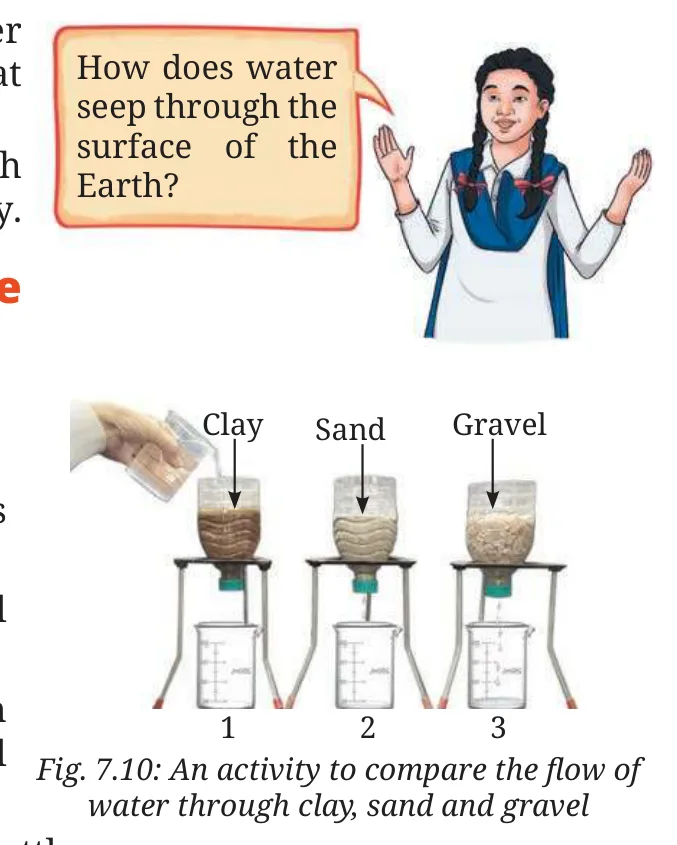
• Place three identical beakers below each bottle.
• Add 200 mL of water to each bottle.
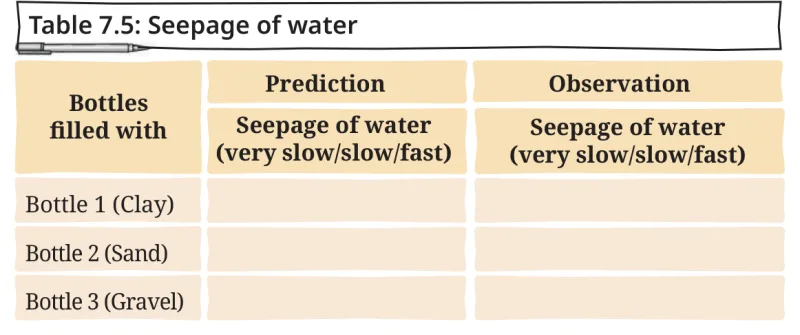
• Predict the amount of water fl owing out of each bottle.
• Collect the water that fl ows through each bottle for 10 minutes.
• Compare the amount of water that comes through each bottle.
Prediction
Observation
Bottles fi lled with
Seepage of water (very slow/slow/fast)
Seepage of water(very slow/slow/fast)
Bottle 1 (Clay)
Bottle 2 (Sand)
Bottle 3 (Gravel)
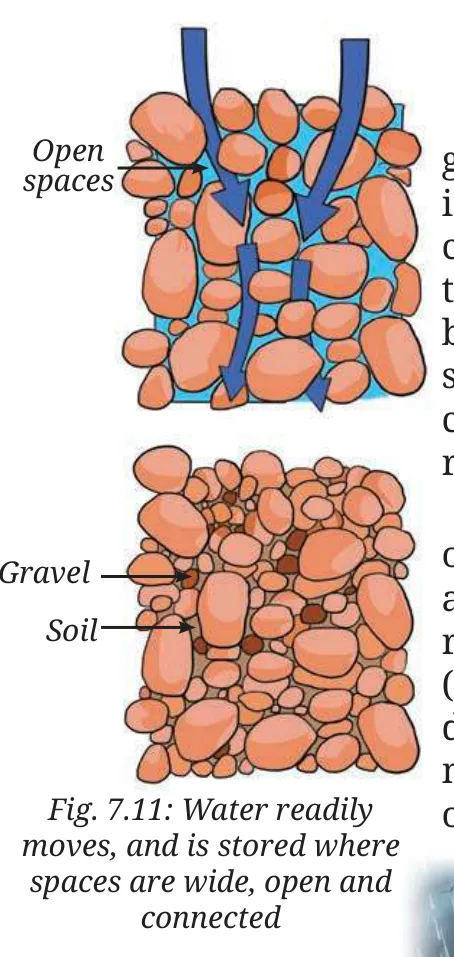
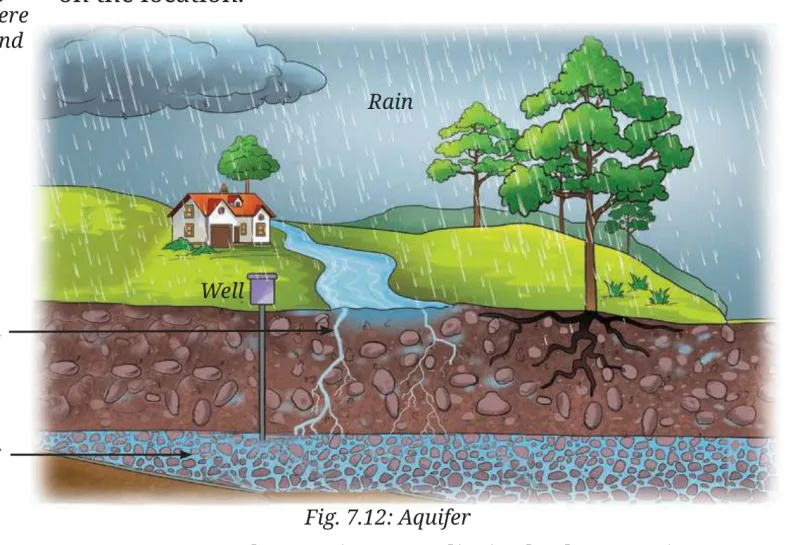
Do your fi ndings match with your predictions?You may have observed that water seeps fastest through gravel, slower through sand, and slowest through clay. Why is it so? The spaces between gravel particles are wider when compared to those in sand and clay. Hence, water can seep through the gravel more easily. In this way, water seeps beneath the surface of the Earth. This process of surface water seeping through soil and rocks is called infi ltration. Water can infi ltrate more readily if the spaces between soil and rock particles are wider, open, and interconnected (Fig. 7.11).The water that seeps through gets stored in the pore spaces of sediments and the openings in rocks beneath the surface as groundwater. The underground layers of sediments and rocks that store water in pore spaces are called aquifers (Fig. 7.12). This is the water we extract by digging wells or drilling bore wells into aquifers. This water may be a few metres to hundreds of metres below the ground, depending on the location.
Open spaces
Gravel
Soil
Rain
Well
Infi ltration
Aquifer
However, groundwater is not unlimited. The growing water requirements of an increasing population have led to excessive groundwater extraction. Additionally, decreased vegetation cover and increased concrete surfaces in urban areas have limited water infi ltration. As a result, groundwater is getting depleted. To address this, rainwater harvesting and recharge pits are used to replenish groundwater. Hence, the water cycle ensures that groundwater sources are recharged, thereby helping to ensure a sustainable groundwater supply.
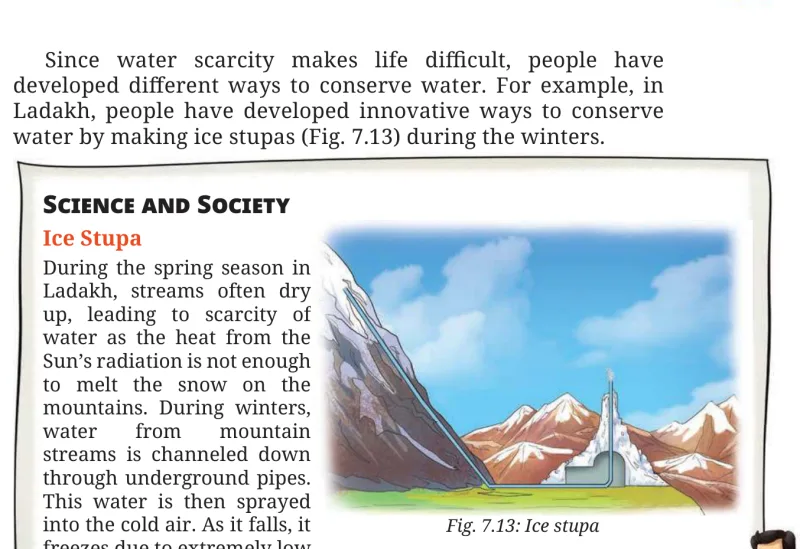
Since water scarcity makes life diffi cult, people have developed diff erent ways to conserve water. For example, in Ladakh, people have developed innovative ways to conserve water by making ice stupas (Fig. 7.13) during the winters.
SCIENCE AND SOCIETY
Ice StupaDuring the spring season in Ladakh, streams often dry up, leading to scarcity of water as the heat from the Sun’s radiation is not enough to melt the snow on the mountains. During winters, water from mountain streams is channeled down through underground pipes. This water is then sprayed into the cold air. As it falls, it freezes due to extremely low temperatures. The ice builds up layer by layer, creating a tall, cone-shaped structure called an ice stupa as shown in Fig. 7.13. The ice stupa melts slowly during spring, providing water for farming and other needs throughout the summer.
In a Nutshell
• There are three ways in which heat is transferred from one place to another — conduction, convection, and radiation.
• The process of heat transfer from the hotter part of an object to a colder part is called conduction. In this process, particles do not move from their positions.
• Materials that allow heat to pass through them easily are called good conductors of heat.
• Materials that do not allow heat to pass through them easily are called poor conductors (insulators) of heat.
• In solids, heat is mainly transferred through the process of conduction. In liquids and gases, heat is transferred by the process of convection.
• In convection, heat transfer takes place by the actual movement of particles. Land and sea breezes are examples of the process of convection. • Heat from the Sun reaches the Earth through radiation. • All objects exchange heat with their surroundings through the process of radiation. • Processes of conduction and convection require a medium for heat transfer but no medium is required for the radiation process. • The principles of heat transfer are utilised in designing houses and clothing. • The continuous movement of water — upward as water vapour and downward through precipitation, passing through soil, rocks and plants, and fi nally returning to water bodies, is called water cycle. • The process of surface water seeping through soil and rocks is called infi ltration. • Groundwater is the water that seeps through and gets stored in the pore spaces of sediments and the openings in rocks beneath the surface. • The underground layers of sediments and rocks that store water in pore spaces are called aquifers.
ENQUIRY
WHY
WHAT IF
WHERE
WHEN
WHATCOULDCAN IT?
HOW
LONG
WHICH
WHOSE
ELSE
WHAT
WHAT WILLHAPPEN
WHAT SHOULDWHY NOT