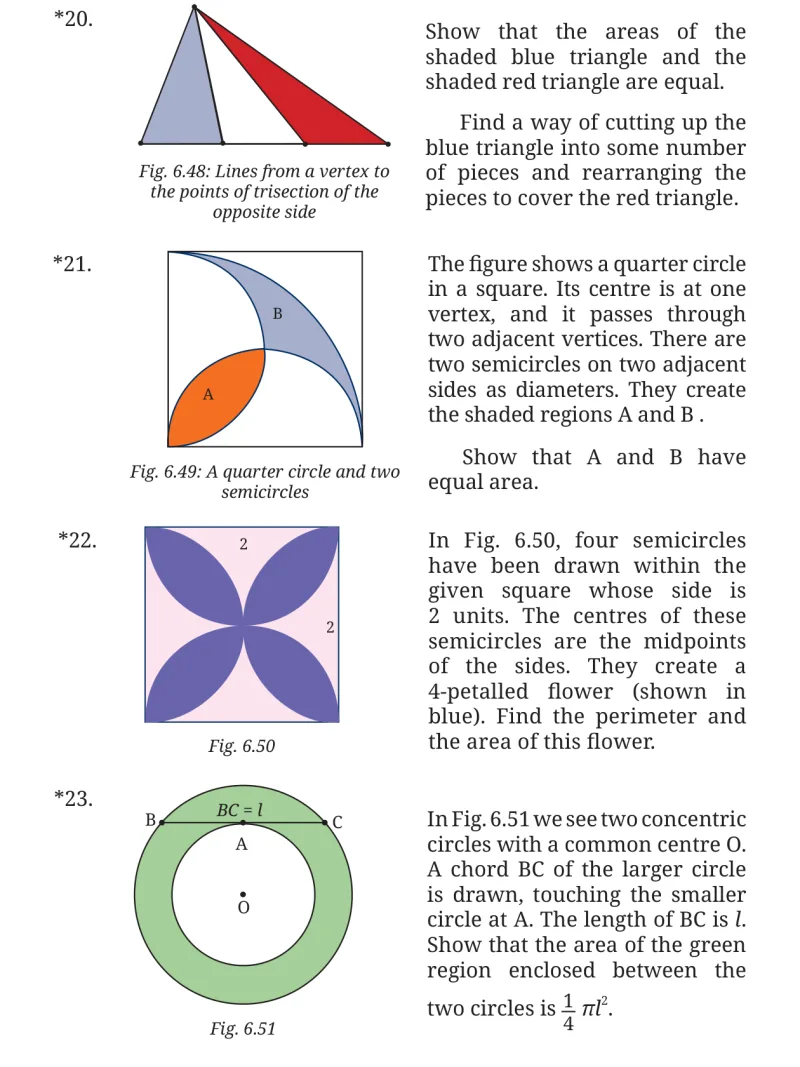
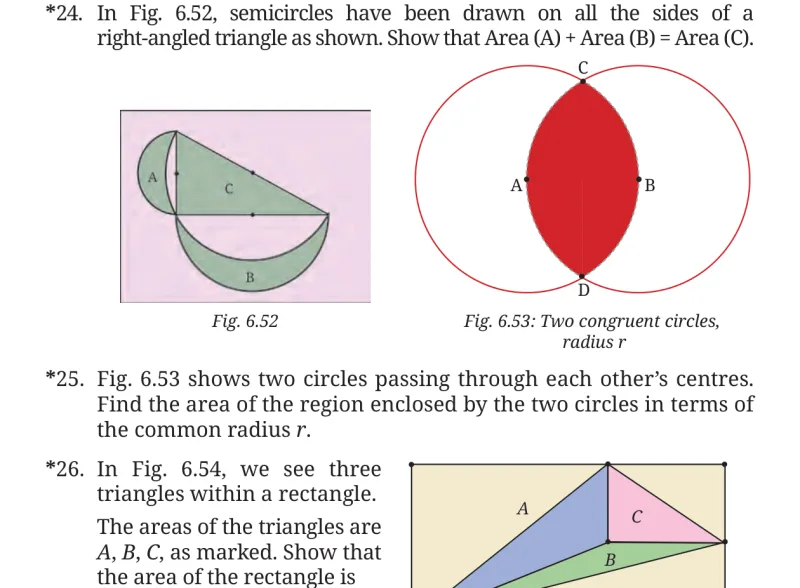
A step-by-step solution for this question is coming soon.
Q2.
An isosceles triangle has perimeter 40 cm; the equal sides are 15 cm each. Find the area of the triangle.
Answer
A step-by-step solution for this question is coming soon.
Q3.
Answer
A step-by-step solution for this question is coming soon.
Q4.
The area of a right-angled triangle is 54 sq. cm. One of its legs has length 12 cm. Find its perimeter.
Answer
A step-by-step solution for this question is coming soon.
Q5.
The sides of a triangle are in the ratio 2: 3: 4, and its perimeter is 45 cm. Find its area.
Answer
A step-by-step solution for this question is coming soon.
Q6.
The sides of a triangle have lengths 7 cm, 24 cm, 25 cm. Find the area of the triangle in two different ways.
Answer
A step-by-step solution for this question is coming soon.
Q7.
If the wheel of a bicycle has a diameter of 60 cm, find how far a cyclist will have travelled after the wheel has rotated 100 times.
Answer
A step-by-step solution for this question is coming soon.
Q8.
Find the area of a quadrant of a circle whose circumference is 66 cm.
Answer
A step-by-step solution for this question is coming soon.
Q9.
The wheel of a car has an outer radius of 28 cm. Calculate how far the car travels after one complete turn of the wheel, and how many times the wheel turns during a journey of 1 km. *10. Two rectangles have the same area and the same perimeter. Does this mean that they are congruent to each other?
Answer
A step-by-step solution for this question is coming soon.
Q11.
Answer
A step-by-step solution for this question is coming soon.
Q12.
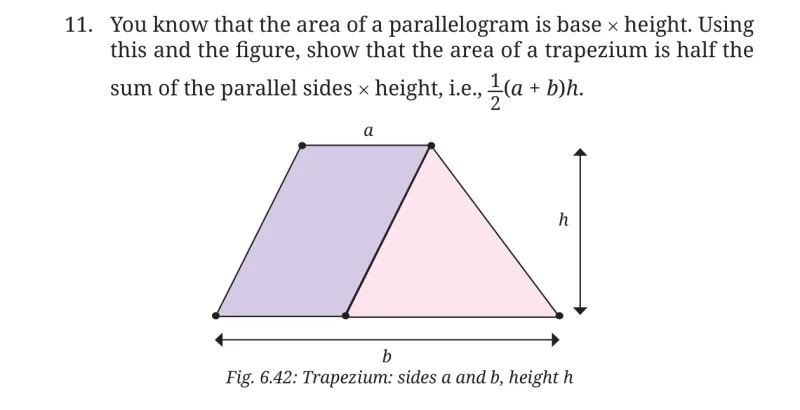
By dividing a trapezium into two triangles show that its area is, half the sum of the parallel sides multiplied by the height (the same formula as the one given above).
Answer
A step-by-step solution for this question is coming soon.
Q13.
Show how we can use two identical copies of a trapezium to make a parallelogram. How will this give us the formula for the area of a trapezium?
Answer
A step-by-step solution for this question is coming soon.
Q14.
Show that the area of a kite is half the product of its diagonals. Show this: (i) using algebra, and (ii) using geometry.
Answer
A step-by-step solution for this question is coming soon.
Q15.
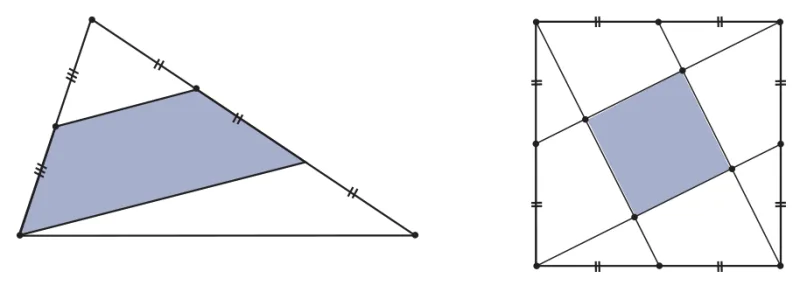
Three problems about fitting congruent shapes together: (i) Rectangle ABCD has sides a, b, and rectangle PQRS has sides 2a, 2b. Show that PQRS has 4 times the area of ABCD. Does this mean that 4 copies of rectangle ABCD will fit into rectangle PQRS? Check and see! (ii) ∆ABC has sides a, b, c, and ∆PQR has sides 2a, 2b, 2c. Show that ∆PQR has 4 times the area of ∆ABC. Does this mean that 4 copies of ∆ABC will fit into ∆PQR? Check and see! (iii) ∆ABC has sides a, b, c, and ∆PQR has sides 3a, 3b, 3c. Show that ∆PQR has 9 times the area of ∆ABC. Does this mean that 9 copies of ∆ABC will fit into ∆PQR? Check and see! *16. Fig. 6.43: What fraction of the triangle is shaded? Fig. 6.44: What fraction of the square is shaded?
Answer
A step-by-step solution for this question is coming soon.
Q17.
Fig. 6.45: What fraction of the rectangle is covered by the circles? Fig. 6.46: What fraction of the rectangle is covered by the circles?
Answer
A step-by-step solution for this question is coming soon.
Q18.
Answer
A step-by-step solution for this question is coming soon.