NCERT Solutions Ganita Manjari Chapter 6 Exercise Set 6.2
Book page 142 Updated on2026-08-11
Q1.
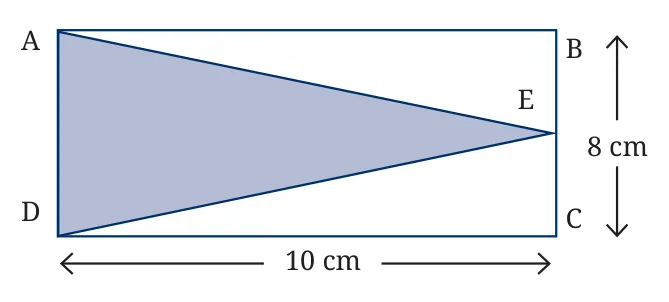
Find the area of triangle ADE in Fig. 6.31. Fig. 6.31
Answer
A step-by-step solution for this question is coming soon.
Q2.
The parallel sides of a trapezium are 40 cm and 20 cm. If its non-parallel sides are both equal, each being 26 cm, find the area of the trapezium.
Answer
A step-by-step solution for this question is coming soon.
Q3.
Find the area of a triangle, given that its sides are 8 cm and 11 cm long, and its perimeter is 32 cm.
Answer
A step-by-step solution for this question is coming soon.
Q4.
The sides of a triangular plot are in the ratio 3: 5: 7; its perimeter is 300 m. Find its area.
Answer
A step-by-step solution for this question is coming soon.
Q5.
Answer
A step-by-step solution for this question is coming soon.
Q6.
ABCD is a parallelogram. P and Q are any two points on side AB. What can you say about the ratio area (∆PCD): area (∆QCD)?
Answer
A step-by-step solution for this question is coming soon.
Q7.
O is any point on the diagonal PR of a parallelogram PQRS. Prove that the areas of triangles PSO and PQO are equal.
Answer
A step-by-step solution for this question is coming soon.
Q8.
If the mid-points of the sides of a 4-gon (also known as a quadrilateral, but we prefer to call it a ‘4-gon’) are joined in order, prove that the area of the parallelogram thus formed will be half of the area of the given 4-gon. (You may wonder whether the 4-gon thus formed is always a parallelogram, and if so, why? These questions will be tackled and answered in the chapter on quadrilaterals.)
Answer
A step-by-step solution for this question is coming soon.
Q9.
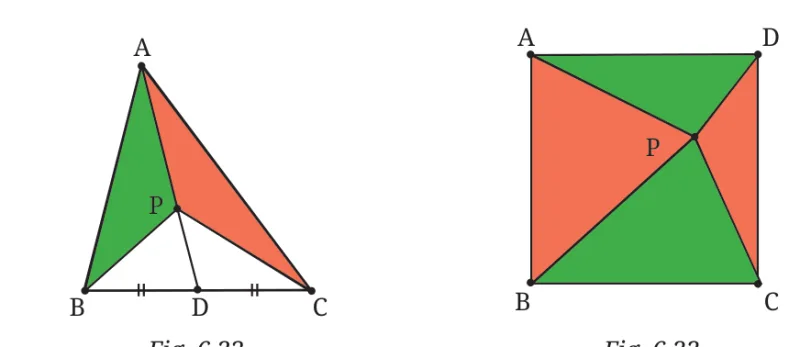
In ∆ABC, the midpoint of BC is D (Fig. 6.32). Median AD is drawn. P is any point on AD. Show that area (∆ABP) = area (∆ACP). Fig. 6.32 Fig. 6.33
Answer
A step-by-step solution for this question is coming soon.
Q10.
Given a square ABCD, let P be a point within it. Join PA, PB, PC, PD (Fig. 6.33). What is the ratio of the areas of the red region (∆PAB and ∆PCD) and the green region (∆PBC and ∆PDA)?
Answer
A step-by-step solution for this question is coming soon.
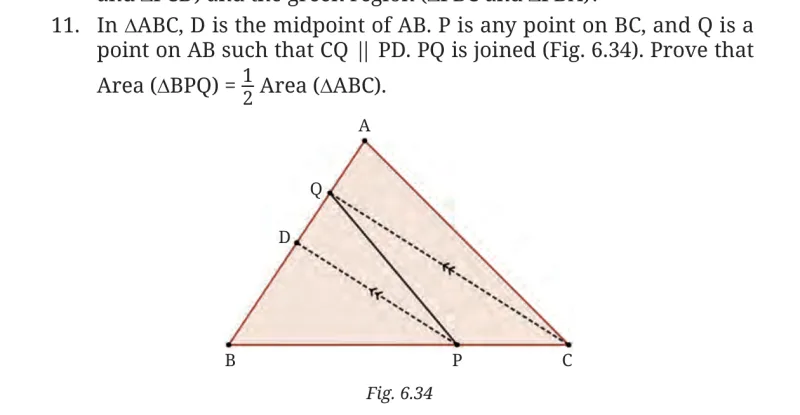
Q11.
Answer
A step-by-step solution for this question is coming soon.