Energy, Matter,
and Life
Think It Over
Life on Earth is powered by a constant flow of energy and matter. The Sun is the main source of energy. In addition, the Earth’s hot interior and chemical reactions in the air, water, and rocks also drive the flow of energy and matter. During the middle stage in Curiosity (Grades 6 – 8) and in earlier chapters of this textbook, you explored these ideas as separate content pieces. For example, you learnt how sunlight drives winds and the water cycle; how plants and microbes cycle nutrients; how the Earth’s tilt causes seasons; and how human activities are modifying air, water, soil and climate. In this chapter, we will consider these processes together as belonging to one Earth system made up of interacting ‘spheres’ —
• How does the warming of Arabian Sea water affect the southwest monsoon in India? • If a large forest is cleared, how can that affect the flow of a river in that area? • What might happen to coastal cities in India if glaciers and polar ice keep melting faster? • How would increasing carbon dioxide levels in the atmosphere affect the ocean plankton?
y
Geosphere: Solid rocks, soil, landforms (like the Deccan
plateau and the Thar desert), and the Earth’s interior. • Hydrosphere: Liquid water in the form of surface water,
such as oceans, rivers (like the Ganga – Brahmaputra river system), lakes and groundwater.
253 Earth as a System: Energy, Matter, and Life
y
Cryosphere: Solid form of water, such as ice and snow (like the
Himalayan glaciers, snow in Ladakh and polar ice caps). • Atmosphere: The air surrounding the Earth that we breathe (cleaner
air in the mountains and forests). • Biosphere: All living organisms and their habitats (including
mangroves, forests, farms, ocean plankton and coral reefs).We will explore how energy and matter move, interact across the Earth’s spheres, and how a change in one affects others. Understanding these processes has been an important part of the continuing journey of the exploration of science. Natural processes, such as heating by solar radiation, movement of air and water, and nutrient cycling connect these spheres in a delicate balance. Let us understand this by conducting Activity 13.1 and explore how different spheres on the Earth continuously interact with each other.
Activity 13.1: Let us explore
1. Observe the features of the Earth as shown
in Fig. 13.1. Identify and circle one example representing each of the geosphere, hydrosphere, cryosphere, atmosphere, and biosphere.2. How does snow (cryosphere) eventually become
part of the lake (hydrosphere)?3. If there is less snowfall during winters for a few
years, how would this affect the lake’s level and the grass available for the sheep?4. Discuss with your classmates and write down
how all the spheres are interconnected, and how a disturbance in one can lead to changes in others.From Activity 13.1, we can infer that a disturbance in one sphere can lead to changes in others. For example, less snowfall in winters may lead to less water in the lake in summers, resulting in less water to support the growth of grass. Similarly, on a large scale, warmer Arabian Sea water lead to more evaporation from the sea. This in turn, causes fluctuations in the southwest monsoon, which results in variability in rainfall, bringing floods to some regions of India while leaving others in drought. This disrupts the hydrosphere. At the same time, the rise in atmospheric temperature could eventually accelerate the melting of glaciers and polar ice in the cryosphere, which may lead to the flooding of low-lying regions, and in the long run, it can raise sea levels that may threaten coastal cities. This could disturb the ecosystems within the biosphere by causing a habitat loss.
Fig. 13.1: Some features of the Earth’s surface
Does the solar radiation heat the Earth’s surface evenly? Let us explore how solar radiation varies from the equator to the poles, the oceans to the mountains, and drives many of Earth’s natural processes, such as wind, ocean current, water cycle, etc.
13.1 Uneven Heating of the Earth
Solar radiation is the main source of energy on the Earth. It reaches the Earth as electromagnetic (EM) waves that travel through a vacuum at
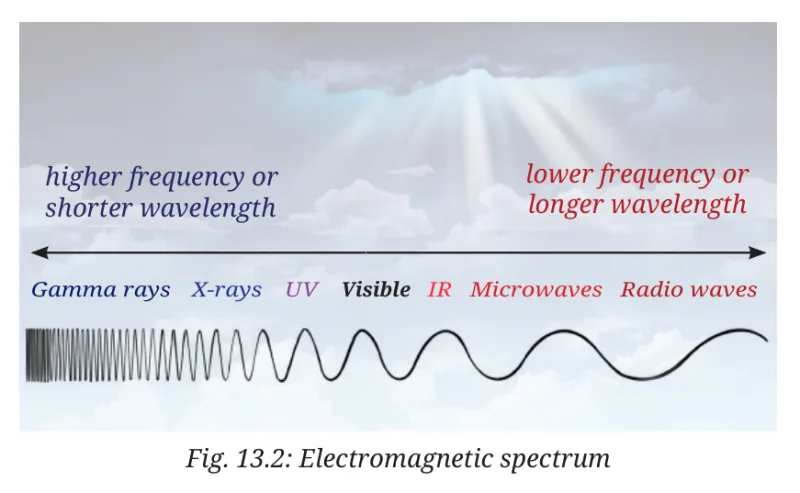
the speed of light (unlike EM waves, sound waves, which you studied in Chapter 10, Sound Waves: Characteristics and Applications, are mechanical waves and require a medium to travel). The speed of light in vacuum is 3 × 10⁸ ms–1. EM waves cover a wide range of frequencies, from high frequency or short wavelength radiation (gamma rays and X-rays) to low frequency or long wavelength radiation (infrared and radio waves). The high frequency EM waves, such as gamma rays and X-rays have very high energy and can be harmful for life on Earth.
The entire range of electromagnetic radiation called electromagnetic spectrum is shown in Fig. 13.2. However, the solar radiation reaching Earth is concentrated mainly in the ultraviolet (UV), visible and infrared (IR) range — about 99 per cent of the Sun’s energy falls within these wavelengths. These three regions of the spectrum shape the Earth’s climate and support life. Gamma rays and X-rays are mostly filtered by the Earth’s upper atmosphere, while microwaves and radio waves carry very little energy to significantly warm the Earth. Short wavelength UV radiation is mostly absorbed by the ozone layer in the upper atmosphere, protecting life and contributing to some atmospheric heating. Visible light from the Sun reaches the Earth’s surface and provides energy for photosynthesis, which is the primary source of food for most organisms. It also partly warms the land and water. Infrared radiation warms the Earth’s surface, which then re-radiates this heat back into the atmosphere. A portion of this outgoing heat is trapped by the greenhouse gases, such as carbon dioxide (CO2), methane (CH4) and water vapour, keeping the Earth warm enough to support life.
lower frequency or
higher frequency orshorter wavelength
longer wavelength
Visible
UVIRRadio wavesMicrowavesX-raysGamma rays
Ready to Go Beyond
The UV rays lie in the wavelength range of 100 nm to 400 nm [1 nanometre (nm) = 10–9 m] and have a much higher energy than the visible light. Prolonged exposure to these rays can damage the eyes and skin, and increase the risk of cancer. Therefore, people should use UV protective glasses and sunscreen if they are likely to be exposed to UV rays. UV rays are also useful in killing germs in water purifiers and help power fluorescent lights.
The amount of the Sun’s radiation that reaches the Earth’s surface is called insolation. It is responsible for warming the Earth’s surface and its atmosphere. The average amount of solar energy received per unit time per unit area that is perpendicular to the Sun’s rays at the top of the Earth’s atmosphere is called the solar constant. Its value is approximately 1.4 kilowatts per square metre (1.4 kWm–2), or about 1400 joules per second per square metre (1400 J s–1m–2). It represents the Sun’s energy available on the Earth before any absorption, scattering or reflection occurs in the atmosphere.
255 Earth as a System: Energy, Matter, and Life
The solar constant is important because it helps scientists understand the Earth’s energy balance, climate and weather patterns. However, some of this energy is absorbed and scattered by gases, clouds and dust particles in the atmosphere before reaching the surface of the Earth. As a result, the maximum insolation reaching the Earth’s surface is lower than the solar constant and is about 1 kWm–2 under clear sky conditions. India, due to its geographical location in the tropical and sub-tropical regions, receives abundant sunlight throughout the year. This makes solar insolation highly significant as it drives the southwest monsoon, which influences India’s climate and agriculture. It also offers immense potential for harnessing solar energy as a renewable and sustainable source of energy.
Bridging Science and Society
Anna Mani, India’s pioneering atmospheric scientist, mapped solar insolation across India in the 1950s. Along with S. Rangarajan, she later published Solar Radiation Over India in 1982, creating the country’s first insolation atlas. Her pioneering measurements showed India’s vast solar energy potential. Today, this is being realised through the large-scale deployment of solar power across the country. India is laying the foundation for a resilient, sustainable and solar-powered energy future that sets global benchmarks.
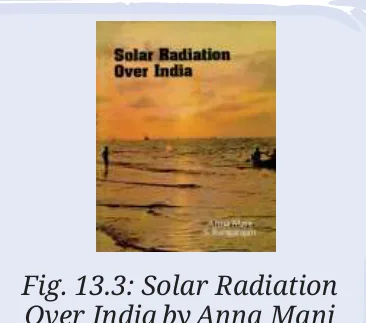
Over India by Anna Mani
and S. Rangarajan
Example 13.1: How much solar energy will be received by a 1 m2 area in one hour, if the insolation on the surface of the Earth were 1 kWm–2 ?
Answer: E = Intensity × area × time
E = 1 × 1000 J s–1 m–2 × 1 m2 × 3600 s
E = 3600000 J = 3.6 × 10⁶ J
(This amount of energy is approximately equal to the energy needed to melt 5 kg of ice and heat the water obtained to 100 °C. It is also equal to one unit of electricity used in a household, as shown on an electricity bill).
Think as a Scientist
An interesting estimation problem that helps us to appreciate the enormous amount of energy that we get from the Sun is to estimate how much of the Earth’s surface would be needed to be covered with solar panels to supply all the electric power that our country uses today (Fig. 13.4). To make this estimate, you can find these numbers on the internet, assume some insolation on the Earth’s surface and consider that some fraction of this energy is converted into electricity. You will probably find that even a fraction of the area of the Thar desert, if covered with solar panels, could supply India’s electricity needs.
Fig. 13.4: Solar panel in the desert
How does the Sun’s radiation interact with the Earth’s surface and atmosphere, and warm the Earth? We will discuss more about it in the following sections.
13.1.1 Interaction of solar radiation on the Earth’s surface
Different materials absorb and heat up differently under sunlight. You have already learnt how land heats up faster than water. There may be some variation due to the material forming the land and the colour of the soil. Dark surfaces absorb more sunlight, while light coloured surfaces reflect more and remain comparatively cooler. For example, dark coloured roads heat up more quickly, while light coloured surfaces remain comparatively cooler. You have also learnt why dark coloured clothes feel hotter than white ones in summer.
Sun(Source of energy)
Partly reflected by
Grade 7CuriosityChapter 7
atmosphere and
clouds
Partly reflected by Earth’s surface
Partly absorbed by atmosphere and clouds
The fraction of solar radiation reflected by a surface is called its albedo (the word ‘albedo’ comes from Latin which means whiteness). High albedo surfaces stay cool because they reflect more light, while low albedo ones heat up more quickly as they reflect less and absorb more light (Fig. 13.5). Let us try to find out the albedo of some of the common objects we come across in our daily lives by conducting Activity 13.2.
Partly absorbed by the Earth’s surface
Fig. 13.5: Solar radiation and warming of
the Earth
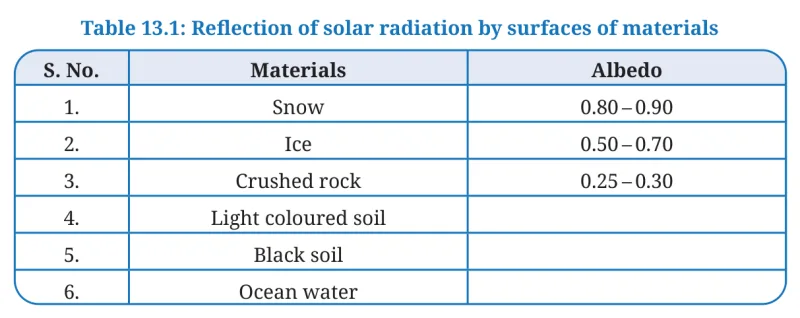
Activity 13.2: Let us find out Complete Table 13.1 using information from authentic sources like websites and books.
NoteEnsure that you do not share any personal information while using the internet.
S. No.Materials Albedo
1.Snow0.80 – 0.90
2.Ice0.50 – 0.70
3.Crushed rock0.25 – 0.30
4.Light coloured soil
5.Black soil
6.Ocean water
From Table 13.1, you must have seen that snow and ice have high albedo, meaning they reflect a large proportion of the incoming solar radiation. This makes polar regions very cold. On the other hand, surfaces like black soil and ocean water have lower albedo as they absorb more solar radiation, and hence, they are relatively warmer.
257 Earth as a System: Energy, Matter, and Life
You have also learnt in the earlier grades that all objects radiate heat. We feel hot inside a concrete house at night especially during hot summer, this is due to the heat re-radiated by the concrete during the night. However, traditional houses built with thick mud and wooden walls offer cool conditions even in hot summer due to less re-radiation.
Grade 7CuriosityChapter 7
Threads of Curiosity
Urban Heat Island EffectCities are warmer than their surrounding rural areas, especially during summer and at night. Compared to rural areas, cities have more built-up areas, including buildings of steel, concrete, brick, and roads made up of concrete and asphalt. All these materials absorb solar radiation and retain heat. The re-radiated heat from these materials warms cities more than the surrounding rural areas. This increases energy demand for air conditioning further stressing the urban ecosystems. Rural areas and forests have more vegetation, and stay cool through shade and plant transpiration. The urban heat island effect shows how human land use can alter the local climate (Fig. 13.6).
Fig. 13.6: Urban heat island effect in a city
The amount of radiation received by a particular region on the Earth’s surface also depends on its latitude. The uneven heating due to the latitude of a place is important as it determines the atmospheric conditions of that place.
13.1.2 Latitude and Earth’s shape
You have already learnt in earlier grades that the Earth is spherical. As a result, the Sun’s rays strike different latitudes at different angles on the Earth. The Sun’s radiation falling on the equatorial region is concentrated over a smaller area, where it is spread over a larger area in the polar region. This is why, equatorial regions remain relatively warm throughout the year, whereas polar regions experience much colder conditions. This uneven heating creates temperature differences between the equator and the poles.
Grade 7Exploring Society:
India and Beyond
Part 1 Chapter 3
You have also learnt how the Earth’s spherical shape and the tilt of the Earth’s axis of rotation give rise to seasons, and the changing length of daytime during one revolution of the Earth around the Sun. Thus, solar radiation is not evenly distributed across the globe. This uneven heating of the Earth’s surface across the globe drives global winds and ocean currents.
Grade 7CuriosityChapter 12
13.1.3 Role of the atmosphere
The air surrounding the Earth is called atmosphere. It is held in place by the force of Earth’s gravity. It consists mainly of nitrogen (78%) and oxygen (21%) along with small amounts of argon, carbon dioxide, water vapour, and other gases.
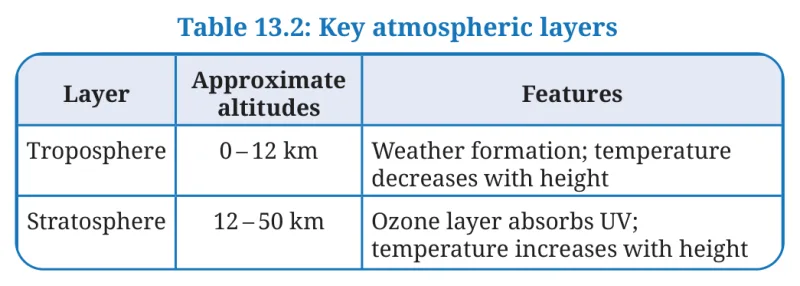
The Earth’s atmosphere has a layered structure. This structure of the atmosphere is important as it helps explain key weather patterns (Fig. 13.7). Nearly, all weather phenomena take place in the troposphere (with an average height of about 12 km), which is heated from the Earth’s surface. In this layer, temperature decreases with height (~6.5 °C/km). As the warm air rises, it drives winds and storms. The height of the troposphere is maximum above the equator and lowest above the polar regions.
Exosphere
Thermosphere
Mesosphere
50 km
Stratosphere
Mount EverestClouds
12 km
Aircraft
Troposphere
In the stratosphere (12 – 50 km), where the ozone layer is located, ozone absorbs UV rays and heats up the atmosphere, so temperature rises with height. This increase in temperature with height in the stratosphere calms the layer due to the lack of vertical mixing of air, keeping weather confined to the troposphere. Above the stratosphere are the mesosphere, thermosphere and exosphere, but they play only a minor role in regulating climate on the surface of the Earth. At about 100 km above the Earth is the start of the region, we call the outer space. These atmospheric layers show how the atmosphere regulates energy flow, shaping weather, climate and life.
0 km
Fig. 13.7: Layers of the Earth’s atmosphere
Meet a Scientist
K.R. Ramanathan, India’s atmospheric scientist, climbed to an altitude of 18,000 feet in the Himalayas in 1934 to measure the ozone levels, and discovered that they were lower than expected. His work laid the foundation for understanding how UV absorption varies with altitude and pollution. Later on, he led early monsoon forecasting efforts.
LayerApproximate altitudesFeatures
Troposphere0 – 12 kmWeather formation; temperature decreases with height
Stratosphere12 – 50 kmOzone layer absorbs UV; temperature increases with height
The atmosphere plays two crucial roles in protecting the life on the Earth. Firstly, it partly absorbs the incoming solar radiation. The ozone layer blocks the harmful UV rays. Clouds and other gases also absorb some sunlight before it reaches the
surface of the Earth (Fig. 13.5). Secondly, it traps outgoing heat. The Earth’s surface absorbs sunlight and re-radiates it in the infrared region. Greenhouse gases like CO2, CH4 and water vapour absorb this re-radiated heat, preventing it from escaping into space. Without the atmosphere, the Earth would be too cold for life to survive. However, excess CO2 from human activities enhances the greenhouse effect, causing global warming, which if left unchecked could make the Earth uninhabitable.
Pause and Ponder
1. Visit the website
given below and study the effect of the concentration of greenhouse gas on
You have also learnt that Venus is hotter than Mercury, even though Mercury is closer to the Sun. This is because of the presence of an atmosphere on Venus, which has led to an uncontrolled greenhouse effect.
Grade 8CuriosityChapter 13
greenhouse-effect
259 Earth as a System: Energy, Matter, and Life
The atmosphere is continuously modified by natural processes, influencing weather, climate and energy balance. When solar radiation and cosmic rays interact with the atmosphere, they influence weather and climate, and affect communication systems. Thus, atmosphere makes the Earth a unique planet.
Threads of Curiosity
Why is the ozone layer so important?The ozone layer is vital to life on the Earth because it acts as a protective shield, absorbing harmful UV radiation from the Sun. When ozone molecules are destroyed faster than they are naturally formed, the layer becomes thinner and less effective. In the late 20th century, human-made chemicals called chlorofluorocarbons (CFCs), used in refrigerators and aerosols, caused severe ozone loss over Antarctica, which came to be known as the ozone hole. Increased UV radiation on the Earth can harm the living organisms and the ecosystems. A global agreement known as the Montreal Protocol reduced the use of CFCs and the ozone layer is now slowly recovering, showing the power of international scientific cooperation.
13.2 Uneven Heating Causes Wind and Ocean Currents
You have learnt that wind is the movement of air from a region of high pressure to a region of low pressure. These pressure differences are mainly caused by the uneven heating of the Earth’s surface by the Sun. Uneven heating of land and water is also responsible for phenomena, such as land and sea breezes, which you have studied earlier. The same basic idea helps us understand the formation of winds and ocean currents on vastly different scales.
Grade 8CuriosityChapter 6
13.2.1 Local winds
Uneven heating of the Earth’s surface also produces local winds, such as valley and mountain breezes. In mountainous regions, the slopes and the valley floor do not heat up and cool down at the same rate. During the day, the mountain slopes facing the Sun are heated more rapidly than the valley floor. As a result, the air over the slopes becomes warm and rises, creating a low pressure region. Cooler air from the valley moves up the slopes to replace the rising warm air. This flow of air is called a valley breeze (Fig. 13.8a).
Warm air
rising
Valley breeze
Valley breeze
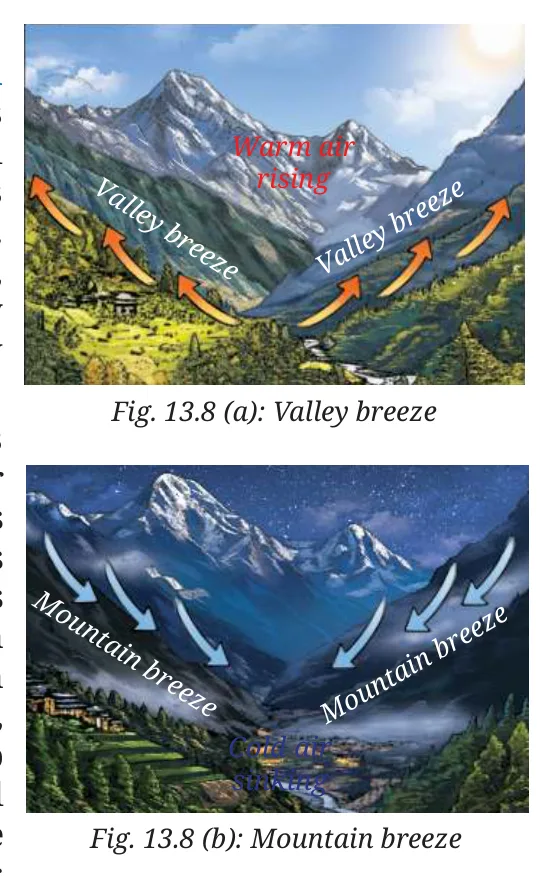
After sunset, the situation reverses. The mountain slopes lose heat faster and become cooler, while the valley floor remains relatively warmer. The air over the slopes becomes cooler and denser, and flows down into the valley. This is known as a mountain breeze (Fig. 13.8b). Such daily changes in the direction of the wind are commonly experienced in hilly regions like Shimla, Dehradun, and other Himalayan valleys. These local winds influence the weather conditions, agriculture and daily life in mountainous regions. They help regulate temperature, moisture conditions and support soil and crop health. Thus, uneven heating of the Earth’s surface sets up winds and forms an important part of the Earth’s atmospheric circulation.
Mountain breeze
Mountain breeze
Cold air
sinking
13.2.2 Planetary winds
Uneven heating of the Earth between the equator and the poles create belts of low and high pressure. This large scale pressure difference sets the air in motion over long distances, giving rise to planetary winds.
Near the equator, intense heating by the Sun causes warm air to rise, forming an equatorial low pressure belt. As this air rises, it moves poleward at higher altitudes. On cooling, it becomes denser and sinks around 30° North and South latitudes, forming the sub-tropical high pressure belts. From these high pressure regions, air flows back towards the equator along the Earth’s surface, completing one circulation cycle (Fig. 13.9a). However, not all the sinking air at the sub-tropical belt returns to the equator. A part of it moves towards the poles along the surface, and rises again around 60° North and South latitudes, where it meets the cold air from the polar regions. This creates the sub-polar low pressure belts.
Clouds
Cool
Cool
air sinks
air sinksWarm air rises
Warm air rises
High PressureHigh Pressure
Low Pressure
30°N0°30°S
Earth’s Surface
Fig. 13.9 (a): Wind circulation between equatorial low pressure belt
and sub-tropical high pressure belt
Ascending airNorth Pole
60° N
Descending
In the polar regions (around 90° North and South), very low temperature causes cold and dense air to sink, forming polar high pressure belts. Air from these regions flows towards the sub-polar belts, completing another circulation cycle (Fig. 13.9b). The Earth’s rotation causes these winds to be deflected from their straight paths. As a result, planetary winds follow curved paths rather than moving directly from high pressure to low pressure regions. The winds are deflected towards the right in the Nothern Hemisphere and towards the left in the Southern Hemisphere due to the rotation of the Earth on its axis.
30° N
air
0°EquatorAscending
air
30° S
Descending
air
60° S
Ascending air
South Pole
Fig. 13.9 (b): The distribution of pressure belts and
planetary winds
13.2.3 Ocean currents
Ocean currents are the continuous movement of large masses of ocean water. Similar to winds, planetary pressure differences also drive the ocean currents. Strong planetary winds drag the surface water of the oceans because of friction, setting surface currents in motion. In addition to winds, differences in temperature and salinity, the rotation of the Earth, and the distribution of land masses influence the movement of ocean water. The water of the equatorial and the polar regions have different
261 Earth as a System: Energy, Matter, and Life
temperatures. While warm equatorial waters travel over the surface toward the poles, colder and denser waters slowly flow back towards the equator through deeper ocean levels. Ocean water has different salinities depending on the location. Water with lower salinity, being less dense, tends to remain near the surface, while higher salinity, denser water sinks and moves at deeper levels in the ocean. The Earth’s rotation deflects these moving water masses, forming large circular patterns called gyres. These rotate clockwise in the Northern Hemisphere and counter clockwise in the Southern Hemisphere (Fig. 13.10a). Continents further modify these paths by blocking and redirecting currents.
Fig. 13.10 (a): Global surface ocean currents showing circulation like gyres
GREENLAND
Ocean currents play a major role in regulating the Earth’s climate and supporting life. By transporting heat from the equator towards the poles, they reduce temperature differences across the planet. For example, the warm ocean current — the North Atlantic Drift (Fig. 13.10b), an extension of the Gulf Stream (a strong ocean current carrying warm water from the southern part of the North American east coast across the Atlantic Ocean) — flows toward the northwestern coast of Europe and keeps many ports ice-free during winter, even at high latitudes. This moderating influence on climate also supports human activities, such as trade and commerce. Ocean currents also support a massive ecosystem by transporting nutrients.
EUROPE
NORTHAMERICA
AFRICA
SOUTHAMERICA
Fig. 13.10 (b): Gulf Stream brings warm water
from the equator
Pause and Ponder
2. How does the cool mountain breeze benefit agriculture activity, particularly the crops and soil?3. What happens to the warm surface of water from the equator as it travels toward the poles?
What impact does this movement have on the area?
India’s Scientific Contributions
Scientists at the Indian Institute of Tropical Meteorology (IITM), Pune, run advanced computer models that couple the energy flows we discussed in this chapter, between atmosphere, oceans, land and ice to simulate the Indian monsoon. These models use data from satellites, buoys in the Indian Ocean, and even stations in Antarctica to improve seasonal forecasts and to study how global warming may change monsoon rainfall patterns across India.
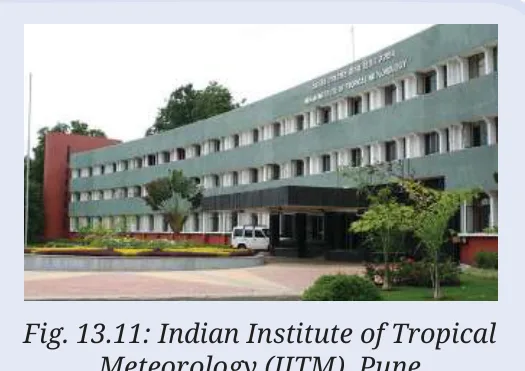
Meteorology (IITM), Pune
13.3 Biogeochemical Cycles
Living organisms constantly exchange matter and energy with the air, water, soil and rocks around them. This continuous interaction between the non-living (abiotic) and living (biotic) components of the Earth results in the transfer of matter and energy across various spheres of the Earth, as discussed earlier. This process ensures that essential nutrients, such as carbon, nitrogen and oxygen are recycled, and remain available to support life on the Earth. This cyclic movement of matter and energy between the abiotic and biotic components is called the biogeochemical cycle. There is a dynamic relationship between different ecosystems. This interconnectedness helps ecosystems recover from disturbances or degradation and maintain environmental balance.
We will examine the water, carbon, nitrogen and oxygen cycles. We will try to understand why their balance matters, and explore how they interconnect across spheres and respond to human impacts.
13.3.1 Water cycle
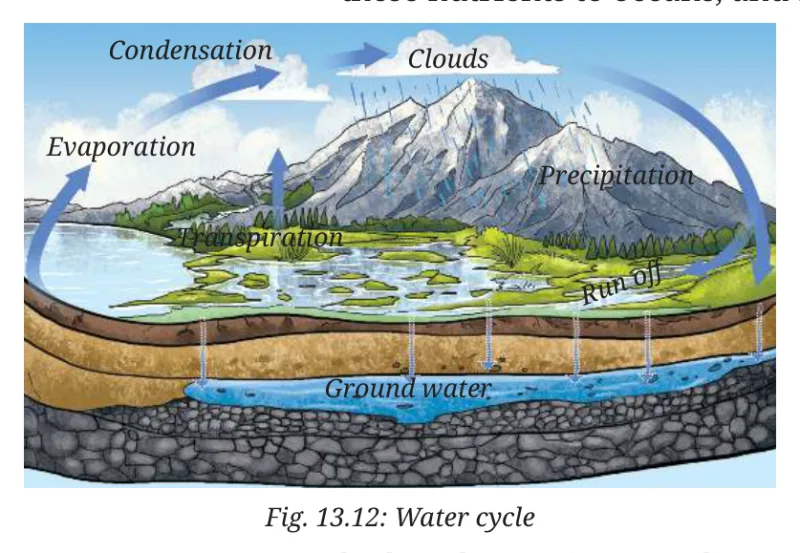
You have studied the water cycle and learnt terms like evaporation, transpiration, condensation, precipitation, infiltration and groundwater. The water cycle is summarised in Fig. 13.12. In this cycle, water evaporates from water bodies, such as rivers, lakes, oceans, etc., and condenses to form clouds. It returns as precipitation in the form of rain, hail or snow to the surface and finally flows back to the ocean. Some of the water seeps through soil and rocks beneath the Earth’s surface. Water dissolves minerals from soil and rocks. It also supports all terrestrial organisms and transports these nutrients to oceans, and support marine life.
Grade 7CuriosityChapter 7
Climate change is now affecting the water cycle. For example, a warmer atmosphere holds more moisture, causing heavier rains in some areas (like intensified monsoons) and droughts elsewhere. Melting glaciers add more water to rivers, raising sea levels in the long run and threatening coastal cities, such as Mumbai and Chennai. Sudden bursts of intense rainfall result in more run off that erodes soil and less infiltration reduces the recharge of groundwater, which in turn, makes sustaining agriculture difficult, especially during dry months. In this way, the water cycle links the cryosphere (glaciers), hydrosphere (rivers and oceans), atmosphere (moisture), geosphere (soil erosion and decreased infiltration), and biosphere (crops and fisheries), all of which are affected by global warming.
Condensation
Clouds
Evaporation
Precipitation
Transpiration
Run off
Ground water
13.3.2 Carbon cycle
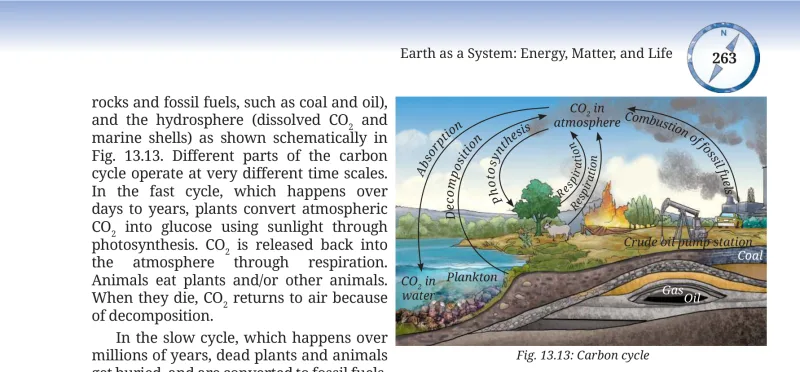
Carbon forms the backbone of life. Every protein, carbohydrate, fat and DNA molecule contains carbon. It circulates continuously between the atmosphere (CO2 gas), biosphere (plants and animals), geosphere (carbonate
263 Earth as a System: Energy, Matter, and Life
rocks and fossil fuels, such as coal and oil), and the hydrosphere (dissolved CO2 and marine shells) as shown schematically in Fig. 13.13. Different parts of the carbon cycle operate at very different time scales. In the fast cycle, which happens over days to years, plants convert atmospheric CO2 into glucose using sunlight through photosynthesis. CO2 is released back into the atmosphere through respiration. Animals eat plants and/or other animals. When they die, CO2 returns to air because of decomposition.
CO2 in atmosphere
Co
bu
st
io
ti
ti
ir
ls
CoalCrude oil pump station
Plankton
CO2 in
GasOil
water
In the slow cycle, which happens over millions of years, dead plants and animals get buried, and are converted to fossil fuels, such as coal, oil and gas. These fuels are burnt to provide energy for various needs like heating, cooking, transportation and industrial purposes. When fossil fuels are burnt, carbon is released back as CO2 on a very short time scale. The atmosphere and ocean water continuously exchange CO2. The ocean water absorbs atmospheric CO2 to form carbonate and bicarbonate ions. Phytoplankton use them for photosynthesis. Some marine organisms also use them to form shells. When organisms die, they sink to the ocean floor and their organic matter is stored as carbon for a long period.
440430420410400390380370360350340330320310 1960 1965 1970 1975 1980 1985 1990 1995 2000 2005 2010 2015 2020 2025
CO2 concentration (ppm)
YearFig. 13.14: Atmospheric CO2 concentration (1960 – 2025), the Keeling curve. The sawtooth pattern shows seasonal dips from yearly plant growth in the Northern Hemisphere absorbing CO2
Human activities like burning fossil fuels and deforestation have raised atmospheric CO2 by about 35% since 1960 as shown in Fig. 13.14 (315 ppm to 420 ppm; ppm denotes parts per million), an unprecedented rise in the history of human civilisation. While some amounts of carbon dioxide are necessary to keep the Earth warm enough to sustain life, the balance is critical. Excessive amounts of CO2 intensify the greenhouse effect leading to global warming, melting of glaciers and Arctic sea ice, rising of sea level and more extreme weather conditions. In India, this may lead to more intense monsoons (warmer air holds more moisture) and threats to agriculture from its changing rainfall patterns. Though fossil fuels still power much of our electricity generation, India is rapidly increasing renewable energy sources, which will help minimise the carbon released into the atmosphere.
Pause and Ponder
4. The CO2
dissolved in the ocean is disturbed when the global temperature increases. What will happen to marine life?
Threads of Curiosity
Carbon constitutes ~ 49% of dry weight of living organisms. Out of the total quantity of global carbon, 71% carbon is found in oceans. This oceanic reservoir regulates the amount of carbon dioxide in the atmosphere.
Do you know that the atmosphere holds only a very small fraction (about 1%) of the total global carbon?
13.3.3 Nitrogen cycle
Nitrogen is an essential element for the synthesis of proteins and nucleic acids in all living organisms. The largest reservoir of nitrogen is in our atmosphere. However, nitrogen gas (N2) is rather non-reactive, and cannot be directly used by plants and animals. It must first be converted to soluble compounds that living beings can absorb. The overall movement of nitrogen between air, soil, water and organisms is called the nitrogen
cycle (Fig. 13.15). The nitrogen cycle contains several steps — nitrogen fixation, assimilation, ammonification, nitrification and denitrification.
Atmospheric N2
NitrificationNitrogen fixation
Nitrogen-fixing bacteria, such as Rhizobium in the root nodules of legumes and Azotobacter in the soil, convert atmospheric N2 into ammonia (NH3). Nitrifying bacteria like Nitrosomonas convert ammonia into nitrite (NO–
Denitrification
if
Decomposers
Ammonia
2), while Nitrobacter convert nitrite into nitrate (NO–
3). This process is known as nitrification. Plants assimilate these nitrogen compounds from the soil, whereas animals obtain nitrogen by consuming plants or other animals. When plants and animals die or produce waste, decomposers like bacteria and fungi break the organic matter, returning nitrogen compounds like ammonia to the soil. This process is known as ammonification. Denitrifying bacteria, such as Pseudomonas convert some nitrates back into nitrogen gas. This process is known as denitrification. This completes the cycle and maintains a balance of nitrogen in ecosystems. Lightning also contributes to the fixation of nitrogen oxides.
Assimilation
NitriteNitrate
Nitrification
Ready to Go Beyond
During lightning strikes, a tiny amount of atmospheric nitrogen is fixed to produce nitrogen oxides. Today most of the nitrogen is fixed artificially via the Haber-Bosch process (early 1900s) of making ammonia from atmospheric nitrogen, which produces most of the fertilisers used today. This ‘Bread from Air’ revolutionised agriculture, enabling India’s Green Revolution and feeding billions. More than half the nitrogen atoms in the human body come from the Haber-Bosch process. However, this reaction is energy intensive (uses ~ 1 – 2% of global energy), and the overuse of fertilisers has degraded soil and water.
13.3.4 Oxygen cycle
Oxygen is one of the Earth’s most abundant elements. About 21% of the atmosphere consist of free oxygen gas (O2). It is an essential component of most biological molecules like carbohydrates, proteins, nucleic acids and fats. Oxygen also exists in combined forms — in the Earth’s crust as
265 Earth as a System: Energy, Matter, and Life
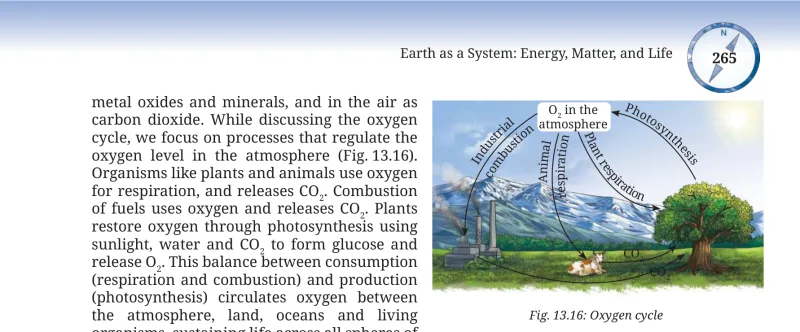
metal oxides and minerals, and in the air as carbon dioxide. While discussing the oxygen cycle, we focus on processes that regulate the oxygen level in the atmosphere (Fig. 13.16). Organisms like plants and animals use oxygen for respiration, and releases CO2. Combustion of fuels uses oxygen and releases CO2. Plants restore oxygen through photosynthesis using sunlight, water and CO2 to form glucose and release O2. This balance between consumption (respiration and combustion) and production (photosynthesis) circulates oxygen between the atmosphere, land, oceans and living organisms, sustaining life across all spheres of the Earth.
O2 in the atmosphere
to
ia
sy
on
tr
nt
Pl
ti
us
he
us
al
an
ti
si
ra
re
ni
co
pi
pi
es
CO2
CO2
Pause and Ponder
5. What would happen to plants and animals on Earth if the biogeochemical cycles were disrupted
and stopped? Explain by giving a few examples.
13.4 Human Impact on Earth’s Processes
You have learnt about the impact of climate change earlier, in which we examined the crises our planet Earth is facing. Rising CO2 levels from the use of fossil fuels leads to extreme weather and biodiversity loss. Here, we will examine how human actions disrupt the biogeochemical cycles across the Earth’s spheres. Excess atmospheric CO2 increases ocean absorption, making sea water more acidic. This could threaten tiny plankton and coral reefs, disrupting the marine ecosystems. However, warmer ocean water reduces the ocean’s capacity to absorb CO2 as an effective carbon sink.
Grade 8CuriosityChapter 13
What if ...
Burning of fossil fuels and deforestation saturate natural carbon sinks like forests and oceans. Over the past 50 years, there has been a significant change in the Earth’s natural systems. In India, fossil fuels still generate a significant part of our electricity, contributing harmful emissions, although the rapid growth of solar energy offers hope. The excess CO2 intensifies greenhouse warming, disrupting the carbon cycle.
photosynthesis stopped, what would happen on the Earth?
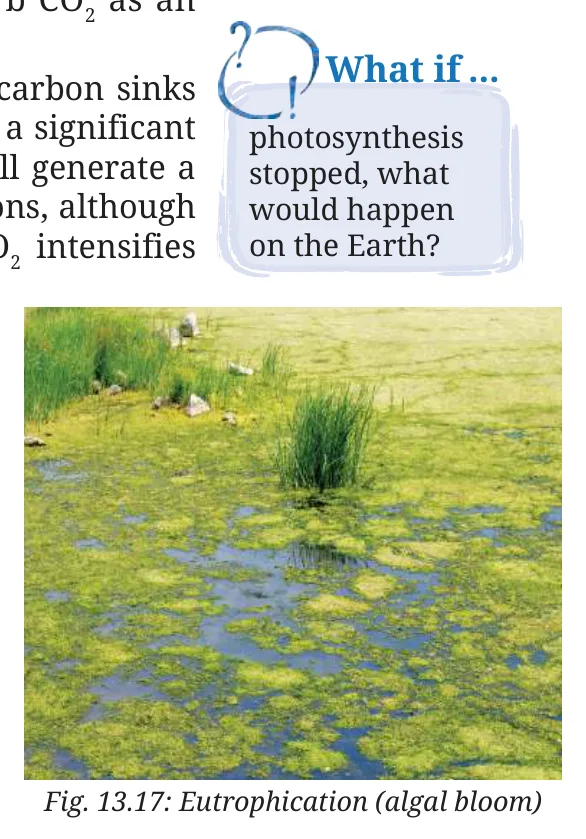
The overuse of fertilisers in agriculture adds excessive nitrogen via nitrates to rivers and lakes, causing widespread growth of algae (algal blooms) that deplete oxygen and kill fish. This process is called eutrophication (Fig. 13.17), which threatens water bodies and coastal fisheries. Deforestation also creates multiple effects across air, water, land and living organisms. Clearing forests results in decreased photosynthesis and reduced transpiration, which can lead to decline in the local rainfall. It also alters surface albedo. Without tree roots to hold the soil together, soil erosion could increase. Over time, habitats could be destroyed, leading to a decline in biodiversity as many species lose their natural homes.
Threads of Curiosity
Vehicular emissions react with sunlight to form ground level smog. This also leads to the formation of ground level ozone, which is harmful for health (remember that ozone in the stratosphere blocks UV radiation and is protective of life). These pollutants make city air unhealthy.
Mission LiFE (Lifestyle for Environment), an India-led global initiative introduced at the United Nations Climate Change Conference in 2021, encourages people to adopt mindful, eco-friendly lifestyles. Traditional practices and ancient texts in India have long recognised that the Earth functions as an interconnected system. The Earth works through the flow of energy and the cycling of matter across spheres. Unsustainable consumption disturbs this balance. By promoting simple habits, such as saving energy and conserving resources, Mission LiFE highlights how the actions of individuals and communities can help build a sustainable future.
While human impact affects all Earth’s spheres, a combination of local actions and global cooperation can help restore the Earth’s natural systems. For example, the Montreal Protocol has started the process of recovery of the ozone layer through global cooperation. However, the Kyoto Protocol and the Paris Agreement in which countries were supposed to reduce their CO2 emissions have been less successful.
Conserving energy and energy resources, switching to renewable energy resources (like solar and wind), planting trees, saving water and practising sustainable farming can help restore the balance. India has planted billions of trees, expanded energy from solar and renewable sources significantly, and also promoted sustainable farming practices. Individuals can also contribute by saving resources (water, food and energy). This can be done by reducing waste, reusing and recycling materials. Together, all these efforts will help maintain the environmental balance on Earth.
Pause and Ponder
6. Discuss how human activities increase the concentration of greenhouse gases in the atmosphere.
What would you do as an individual to reduce the emission of greenhouse gas?
At a Glance
y
The electromagnetic radiation received from the Sun is the primary
source of energy on the Earth. • Most weather processes like evaporation, condensation and precipitation occur in the troposphere. • The shape of the Earth, latitude and tilt of the Earth’s axis are primarily
responsible for variations in insolation, and hence, for the uneven heating of the Earth’s surface. • Uneven heating of the Earth’s surface is responsible for the generation
of winds and ocean currents. • Matter and energy are continuously cycled between the living (biotic)
and the non-living (abiotic) systems. • Atmospheric oxygen is used in combustion, respiration and oxide
formation, and is restored mainly through photosynthesis. • On the Earth, water, carbon, nitrogen and oxygen continuously cycle
between the atmosphere, oceans, land and living organisms. • Biogeochemical cycles make nutrients available to living organisms,
sustain life, regulate climate and balance ecosystems.
267 Earth as a System: Energy, Matter, and Life